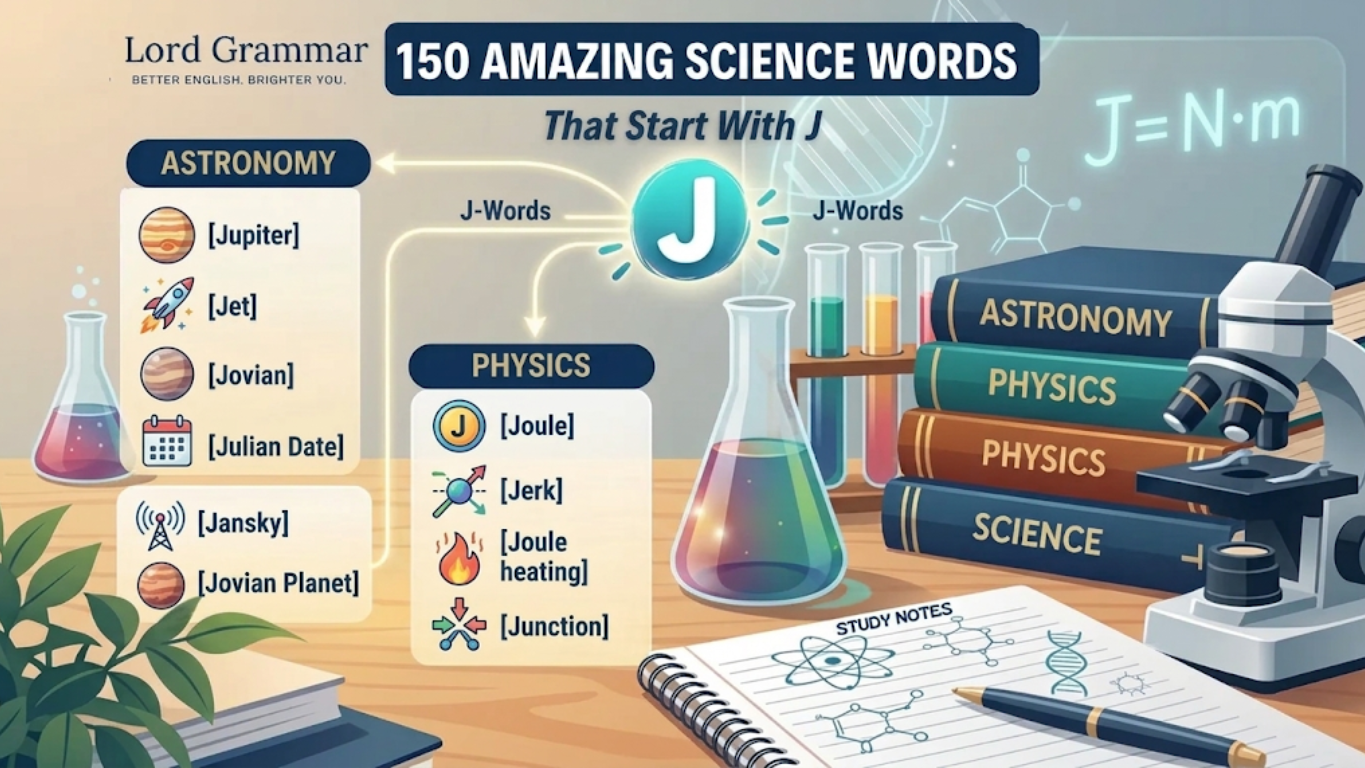
Science helps us understand the world around us. It explains how plants grow, how energy works, and how planets move through space. Learning new science words can make these ideas easier to understand.
This guide to science words that start with J covers terms from physics, biology, chemistry, astronomy, geology, and other fields. Each word has a simple meaning and an example sentence to help you understand how it is used.
The letter J has fewer scientific terms than many other letters. Still, it includes useful words such as joule, Jupiter, joint, and jet stream. You will also discover more advanced terms that scientists use in research and experiments.
Why Learn Science Words That Start With J?
Learning science words that start with J can help students build vocabulary and understand school lessons. These words describe energy, living things, body parts, space, materials, and natural events.
Some terms are easy to recognize, while others may be new to you. Knowing their meanings can help you read science books, understand classroom discussions, and write clearer answers in exams.
The lists below include common terms and more specialized scientific vocabulary. Each definition is kept simple, while the scientific meaning remains accurate.
Astronomy and Space Science Words That Start With J
Space science studies planets, stars, galaxies, and the wider universe. These science words that start with J include names of planets, space missions, and ideas used to study objects beyond Earth.
| Word | Origin | Meaning | Example Sentence |
|---|---|---|---|
| Jupiter | Roman mythology | The largest planet in our solar system. | Jupiter has many moons. |
| Jovian | Latin, from Jupiter | Relating to Jupiter or similar giant planets. | Scientists study Jovian planets around distant stars. |
| Jovian planet | From Jupiter | A giant planet similar to Jupiter in size or nature. | Saturn is often grouped with Jovian planets. |
| Jupiter’s Great Red Spot | Named for Jupiter | A huge, long-lasting storm in Jupiter’s atmosphere. | Jupiter’s Great Red Spot is easy to recognize in many images. |
| Jupiter’s magnetosphere | Jupiter + Greek sphaira | The region controlled by Jupiter’s magnetic field. | Jupiter’s magnetosphere traps charged particles. |
| Jupiter’s magnetotail | Jupiter + magnetism + tail | The long extension of Jupiter’s magnetic field away from the Sun. | Solar wind can stretch Jupiter’s magnetotail. |
| Jupiter’s rings | Jupiter + ring | The faint ring system around Jupiter. | Jupiter’s rings are much fainter than Saturn’s rings. |
| Jupiter trojans | Jupiter + Trojan, from Greek legend | Asteroids that share Jupiter’s orbit around the Sun. | Jupiter trojans travel around the Sun near Jupiter’s orbital path. |
| Juno mission | Named after the Roman goddess Juno | NASA’s mission that studies Jupiter. | The Juno mission has collected data about Jupiter’s atmosphere. |
| James Webb Space Telescope | Named after James E. Webb | A space telescope that observes infrared light. | The James Webb Space Telescope studies distant galaxies. |
| Jansky | Named after Karl Jansky | A unit used to measure radio-source strength in astronomy. | Astronomers may report a radio source’s brightness in janskys. |
| Julian day | Named for the Julian dating system | A continuous count of days used in astronomy and other fields. | Astronomers use the Julian day to record observations. |
| Julian date | From the Julian day system | A date value based on a continuous day-count system. | The researcher recorded the observation’s Julian date. |
| Jeans instability | Named after James Jeans | A process in which a gas cloud can collapse under gravity. | Jeans instability can help explain how stars form. |
| Jet (astrophysics) | Common English word | A narrow stream of matter moving rapidly from an astronomical object. | The black hole produced a powerful jet. |
Physics Words That Start With J
Physics explores energy, motion, forces, electricity, and matter. These science words that start with J describe important measurements, effects, and physical systems.
| Word | Origin | Meaning | Example Sentence |
|---|---|---|---|
| Joule | Named after James Prescott Joule | The SI unit of energy and work. | Lifting a small object requires energy measured in joules. |
| Joule heating | Named after James Prescott Joule | Heat produced when electric current passes through resistance. | Joule heating can warm an electric wire. |
| Joule’s law | Named after James Prescott Joule | A relationship describing heat produced by electric current in a resistance. | Joule’s law helps explain heat loss in circuits. |
| Joule-Thomson effect | Named after Joule and William Thomson | A temperature change that occurs when a real gas expands under suitable conditions without external work. | The Joule-Thomson effect is used in some gas-cooling systems. |
| Jerk | English physics term | The rate at which acceleration changes over time. | A sudden change in a car’s acceleration can create a jerk. |
| Jerk sensor | From the physics term jerk | A device or measurement system used to detect changes in acceleration over time. | The test system recorded jerk during the sudden stop. |
| Josephson effect | Named after Brian Josephson | Quantum effects that allow current to pass between superconductors under suitable conditions. | The Josephson effect has uses in precision measurements. |
| Josephson junction | Named after Brian Josephson | A device made from two superconductors separated by a thin barrier. | A Josephson junction can be part of a quantum circuit. |
| Johnson noise | Named after John B. Johnson | Random electrical noise caused by thermal motion of charge carriers. | Johnson noise can affect sensitive electronic measurements. |
| Joule cycle | Named for Joule | A thermodynamic cycle used in the study of heat and work. | The class compared the Joule cycle with other thermodynamic cycles. |
| Joule expansion | Named after Joule | Expansion of a gas into an empty space in a classic thermodynamics experiment. | Joule expansion helped scientists study gas behavior. |
| Joule balance | Named after Joule | An instrument or experimental arrangement used to study energy or electrical measurements, depending on the design. | The laboratory used a joule balance for a precision experiment. |
| J-pole antenna | Named for its shape | An antenna with a shape resembling the letter J. | The radio club built a J-pole antenna. |
| JFET (junction field-effect transistor) | Technical abbreviation | A transistor that controls current using an electric field. | The circuit uses a JFET to control the signal. |
| Junction diode | English technical term | A semiconductor device made from a p-n junction that mainly conducts in one direction. | A junction diode allows current to pass more easily in one direction. |
Chemistry Words That Start With J
Chemistry studies substances, their properties, and how they change. These J terms include minerals, chemical compounds, and effects that help explain how atoms and molecules behave.
| Word | Origin | Meaning | Example Sentence |
|---|---|---|---|
| Jahn-Teller effect | Named after Hermann Jahn and Edward Teller | A distortion that can occur in certain molecules or complexes to lower their energy. | The Jahn-Teller effect can change a molecule’s shape. |
| Jarosite | Mineral name with historical roots | A mineral containing iron, sulfate, and potassium or related elements. | Scientists studied jarosite in the rock sample. |
| Jadeite | Mineral name from jade | A mineral that is one of the main materials called jade. | Jadeite can form green gemstones. |
| Jasmone | From jasmine | An organic compound associated with the scent of jasmine. | Jasmone contributes to the smell of some plants. |
| Jasmonic acid | From jasmine-related naming | A plant signaling compound involved in growth and defense. | Jasmonic acid helps a plant respond to insect damage. |
| Jervine | Historical chemical name | A naturally occurring steroidal alkaloid found in certain plants. | Researchers study jervine to understand its chemical properties. |
| J-aggregate | Named for its characteristic molecular arrangement | An arrangement of dye molecules with distinctive optical properties. | A J-aggregate can absorb light differently from isolated dye molecules. |
| Jones reagent | Named after chemist John C. Jones | A chromium-based reagent used to oxidize certain organic compounds. | Jones reagent can convert a suitable alcohol into a carbonyl compound. |
| Jander equation | Named after its developer | A mathematical model used to describe certain solid-state reactions. | The researcher compared the data with the Jander equation. |
| Jander’s method | Named after its developer | A method used in studying the rate of some solid-state reactions. | Jander’s method helped analyze the reaction data. |
| Jellification | From jelly | The process of forming a gel from a liquid or mixture. | Cooling caused the mixture’s jellification. |
| Jellium model | From jelly + -ium | A simplified model of electrons in a positive background, often used to study metals. | The jellium model helps explain some properties of metals. |
| Jet milling | From jet | A process that uses fast-moving gas to grind materials into fine particles. | Jet milling produced a fine chemical powder. |
| Juniperic acid | Named from juniper | A fatty acid associated with certain waxes and plant materials. | The chemist investigated juniperic acid in the sample. |
| Jacobsite | Named after a locality | A mineral made mainly of manganese and iron oxides. | Jacobsite was identified in the mineral collection. |
Biology Words That Start With J
Biology is the study of living things. These science words that start with J describe animals, insects, plants, and biological processes.
| Word | Origin | Meaning | Example Sentence |
|---|---|---|---|
| Jellyfish | English compound | A soft-bodied marine animal with tentacles. | A jellyfish drifted through the water. |
| Jellyfish medusa | Greek Medousa | The free-swimming, bell-shaped body form of many jellyfish. | The jellyfish medusa moved through the sea. |
| Juvenile | Latin juvenilis | A young organism that has not reached adulthood. | The juvenile turtle stayed near the shore. |
| Juvenile hormone | English scientific term | An insect hormone that helps control development and metamorphosis. | Juvenile hormone affects how an insect develops. |
| Jumping gene | English scientific term | A DNA sequence that can move to a new position in a genome. | A jumping gene can change where DNA information sits. |
| J-protein | Scientific naming convention | A protein that helps other proteins fold or work correctly. | The J-protein helped another protein fold. |
| J-chain | Scientific abbreviation | A protein that joins certain antibody molecules together. | The J-chain helps link some antibody units. |
| JAK protein | Abbreviation for Janus kinase | A protein involved in signaling inside cells. | A JAK protein helps pass signals within a cell. |
| JAK-STAT pathway | Named for JAK and STAT proteins | A cell-signaling pathway that helps cells respond to chemical messages. | The JAK-STAT pathway helps control some immune responses. |
| Juxtacrine signaling | Latin-derived juxta + crinis | Cell communication that requires cells to touch or be very close. | Juxtacrine signaling allows neighboring cells to exchange information. |
| Junctional complex | Biological technical term | A group of cell connections that help cells stick together and form barriers. | A junctional complex helps seal neighboring cells. |
| Junctional epithelium | Anatomical term | Gum tissue that attaches to the surface of a tooth. | The junctional epithelium helps protect the tooth’s supporting tissues. |
| Janthinobacterium | Scientific genus name | A genus of bacteria that includes species found in soil and water. | Researchers found Janthinobacterium in a water sample. |
| Jatropha | Botanical genus name | A genus of flowering plants that includes several tropical species. | Jatropha plants grow in warm regions. |
| Juncus | Latin plant name | A genus of rushes that often grow in wet places. | Juncus grew along the edge of the pond. |
Anatomy and Medical Words That Start With J
Anatomy studies body structures, while medicine focuses on health and disease. These terms describe organs, tissues, body functions, and health conditions.
| Word | Origin | Meaning | Example Sentence |
|---|---|---|---|
| Joint | Old French and Latin roots | A place where two or more bones meet or connect. | The knee is a joint that helps the leg bend. |
| Jejunum | Latin jejunus | The middle section of the small intestine. | Nutrients are absorbed in the jejunum. |
| Jugular vein | Latin jugulum, meaning throat | A major vein that carries blood from the head and neck toward the heart. | The jugular vein carries blood away from the head. |
| Jaundice | French medical term with Greek roots | Yellowing of the skin and eyes caused by a buildup of bilirubin. | Jaundice can cause the whites of the eyes to look yellow. |
| Jaw | Old English ceowan, meaning to chew | The bone structure that supports the teeth and helps with chewing. | The jaw moves as a person chews food. |
| Jawbone | English compound | A bone of the upper or lower jaw. | The jawbone supports the teeth. |
| Joint capsule | English anatomical term | A layer of tissue that surrounds a movable joint. | The joint capsule helps protect the knee joint. |
| Joint cartilage | English anatomical term | Smooth tissue that covers the ends of bones in many joints. | Joint cartilage helps bones move with less friction. |
| Joint fluid | English anatomical term | Fluid inside many movable joints that helps reduce friction. | Joint fluid helps the knee move smoothly. |
| Joint ligament | Latin ligare, meaning to bind | A strong band of tissue that connects bones at a joint. | A joint ligament helps stabilize the ankle. |
| Joint effusion | Latin effundere, meaning to pour out | An abnormal buildup of fluid inside a joint. | The doctor checked the knee for joint effusion. |
| Joint inflammation | Latin inflammare, meaning to set alight | Swelling and irritation in or around a joint. | Joint inflammation can make movement painful. |
| Juxtaglomerular cells | Latin juxta + glomerulus | Kidney cells that help regulate blood pressure and kidney function. | Juxtaglomerular cells release renin under certain conditions. |
| Juxtamedullary nephron | Latin-derived anatomical term | A kidney nephron located near the inner region of the kidney’s outer zone. | A juxtamedullary nephron helps the kidney concentrate urine. |
| Jejunostomy | Jejunum + Greek stoma, meaning opening | A surgically created opening into the jejunum, often used for feeding access. | The patient received nutrition through a jejunostomy tube. |
Genetics and Cell Science Words That Start With J
Genetics explores DNA, genes, and inherited traits. Cell science examines how cells are built and how they function. The following words cover genetic changes, cell connections, and molecular processes.
| Word | Origin | Meaning | Example Sentence |
|---|---|---|---|
| J gene segment | Immunology and genetics term | A joining segment of DNA used in making certain immune-system receptors and antibodies. | A J gene segment contributes to antibody diversity. |
| J region | Genetics term | A joining region in certain immune-system genes. | The J region helps form a working antibody gene. |
| Junctional diversity | Genetics term | The variety created when immune-system gene segments join in different ways. | Junctional diversity helps the body recognize many threats. |
| Junctional sequence | Scientific compound | A DNA or protein sequence found where two regions meet. | The scientist examined the junctional sequence. |
| Junctional mutation | Scientific compound | A mutation located at or affecting a joining region. | The study identified a junctional mutation. |
| Junctional adhesion molecule | Scientific protein name | A protein involved in cell adhesion and certain signaling processes. | A junctional adhesion molecule helps cells connect. |
| Junctional complex protein | Scientific compound | A protein that forms part of a cell’s connection or barrier system. | The junctional complex protein helped maintain the cell barrier. |
| Junctional epistasis | Genetics term | A form of gene interaction studied in specific genetic contexts involving connected or neighboring effects. | The researchers tested for junctional epistasis in their model. |
| Jumping DNA | Informal scientific term | DNA that can move from one place in the genome to another. | Jumping DNA can affect gene activity. |
| Junk DNA | Historical term | A former broad label for DNA that does not code for proteins; some such DNA has important functions. | Some regions once called junk DNA help control genes. |
| J-shaped growth curve | Scientific descriptive term | A growth pattern that rises rapidly and forms a shape like the letter J. | The population showed a J-shaped growth curve. |
| J-shaped dose-response curve | Scientific descriptive term | A dose-response pattern in which outcomes change in a J-like shape across exposure levels. | The researchers examined a J-shaped dose-response curve. |
| JAK-STAT signaling | Named for pathway proteins | A signaling process in which JAK and STAT proteins carry messages within cells. | JAK-STAT signaling helps cells respond to certain hormones. |
| JNK pathway | Short for c-Jun N-terminal kinase pathway | A cell-signaling pathway involved in stress responses and other cell activities. | The JNK pathway became active under cellular stress. |
| Junctional remodeling | Scientific compound | Changes in the structures that connect neighboring cells. | Junctional remodeling helped the tissue respond to injury. |
Earth Science and Geology Words That Start With J
Earth science studies rocks, landforms, minerals, and the processes that shape our planet. These terms include geological time periods, minerals, and natural events.
| Word | Origin | Meaning | Example Sentence |
|---|---|---|---|
| Jurassic | Named after the Jura Mountains | A geological period that lasted about 201 to 145 million years ago. | Many well-known dinosaurs lived during the Jurassic. |
| Jurassic Period | Named after the Jura Mountains | The middle period of the Mesozoic Era. | The Jurassic Period followed the Triassic Period. |
| Jurassic rock | Geological descriptive term | Rock formed during the Jurassic Period. | The geologist studied Jurassic rock for fossils. |
| Jurassic fossil | Geological descriptive term | A fossil preserved from the Jurassic Period. | The Jurassic fossil revealed an ancient marine animal. |
| Jasper | Historical gemstone name | An opaque variety of quartz-rich rock used as a gemstone. | The red jasper had dark bands. |
| Jadeite | Mineral name | A mineral found in some types of jade. | Jadeite can contain traces of iron. |
| Jarosite | Mineral name | An iron sulfate mineral that can form in acidic environments. | Jarosite was found in the mineral sample. |
| Jacobsite | Named after a locality | A manganese-iron oxide mineral. | Jacobsite was identified in the rock specimen. |
| Jökulhlaup | Icelandic | A sudden flood caused by the release of water from beneath or near a glacier. | The glacier’s sudden drainage caused a jökulhlaup. |
| Joint (geology) | Common English word | A crack in rock where there has been little or no movement parallel to the crack. | Water entered the rock through a joint. |
| Joint set | Geological term | A group of rock joints with a similar direction or pattern. | The geologist mapped a joint set on the cliff. |
| Joint system | Geological term | Several related sets of fractures in a rock mass. | The joint system affected how the rock broke apart. |
| Jointing | Geological term | The formation or presence of joints in rock. | Jointing made the rock easier to split. |
| Jurassic limestone | Geological descriptive term | Limestone deposited during the Jurassic Period. | The cave formed in Jurassic limestone. |
| Juvenile water | Geological term | Water derived from deep within Earth and introduced into the hydrologic system through geological processes. | Researchers considered whether juvenile water contributed to the spring. |
Weather and Atmospheric Science Words That Start With J
Atmospheric science explores air, wind, clouds, and weather patterns. These words describe air movement, weather systems, and ways scientists study the atmosphere.
| Word | Origin | Meaning | Example Sentence |
|---|---|---|---|
| Jet stream | English compound | A narrow band of strong winds high in the atmosphere. | The jet stream can influence storm paths. |
| Jet-stream wave | Atmospheric science term | A wave-like bend in the path of a jet stream. | A jet-stream wave helped guide the weather system. |
| Jet-stream wind | Atmospheric science term | Fast-moving wind within a jet stream. | Jet-stream wind can move weather systems across a region. |
| Jet streak | Atmospheric science term | A region of especially strong wind within a jet stream. | A jet streak affected the storm’s development. |
| Jet maximum | Atmospheric science term | A location or region where jet-stream wind speed reaches a maximum. | The forecast showed a jet maximum over the ocean. |
| Jet core | Atmospheric science term | The central region of strongest wind in a jet stream. | The aircraft avoided the strongest part of the jet core. |
| Jet exit region | Atmospheric science term | The downstream part of a jet streak. | The jet exit region influenced air movement above the storm. |
| Jet entrance region | Atmospheric science term | The upstream part of a jet streak. | The jet entrance region helped shape the wind pattern. |
| Jet stream shear | Atmospheric science term | A change in wind speed or direction across a jet stream. | Jet stream shear affected the storm’s structure. |
| Jet-stream turbulence | Atmospheric science term | Turbulence linked to strong winds and wind differences near a jet stream. | Jet-stream turbulence can affect aircraft. |
| Jet stream forecast | English scientific compound | A prediction of the position and strength of a jet stream. | The jet stream forecast helped meteorologists track the storm. |
| Jet ventilation | Technical descriptive term | Air movement or flushing caused by a jet of air in a system. | Jet ventilation moved fresh air through the test chamber. |
| Jet mixing | Scientific compound | The mixing of surrounding material caused by a fast-moving fluid stream. | Jet mixing spread the warmer water through the tank. |
| Jet diffusion | Scientific compound | The spreading of a jet as it mixes with the surrounding fluid. | Jet diffusion widened the stream of air. |
| Jet instability | Fluid-dynamics term | A disturbance that grows in a moving jet of fluid or gas. | Jet instability changed the shape of the water stream. |
Mathematics and Computing Words That Start With J
Mathematics and computing help scientists analyze data, build models, and solve problems. These terms include mathematical tools, data formats, and ideas used in computer science.
| Word | Origin | Meaning | Example Sentence |
|---|---|---|---|
| Jacobian | Named after Carl Gustav Jacob Jacobi | A matrix of first-order partial derivatives used in multivariable calculus. | The scientist calculated the Jacobian of the model. |
| Jacobian matrix | Named after Carl Gustav Jacob Jacobi | A matrix that summarizes how several outputs change with several inputs. | The Jacobian matrix helped test the model’s stability. |
| Jacobian determinant | Mathematical term | The determinant of a Jacobian matrix, often used in coordinate transformations. | The Jacobian determinant helped convert the integral. |
| Jacobian transformation | Mathematical term | A change of variables that uses a Jacobian to account for changes in scale. | The Jacobian transformation simplified the calculation. |
| Jordan curve | Named after Camille Jordan | A simple closed curve in a plane. | A circle is an example of a Jordan curve. |
| Jordan curve theorem | Named after Camille Jordan | A theorem stating that a simple closed plane curve separates the plane into an inside and an outside. | The Jordan curve theorem describes the regions around a closed curve. |
| Jordan form | Named after Camille Jordan | A special matrix form used in linear algebra. | The student found the Jordan form of the matrix. |
| Jordan matrix | Mathematical term | A matrix with a special block structure used in linear algebra. | The Jordan matrix helped explain the system’s behavior. |
| Julia set | Named after Gaston Julia | A set of points linked to the repeated application of a complex function. | The computer displayed a colorful Julia set. |
| Julia fractal | Named after Gaston Julia | A fractal image or structure based on a Julia set. | The Julia fractal showed a repeating pattern. |
| Jupyter Notebook | Named after Julia, Python, and R | An interactive tool for writing code, notes, and data analysis together. | The researcher used a Jupyter Notebook to analyze the results. |
| JSON | JavaScript Object Notation | A text format used to store and exchange structured data. | The program saved the measurements in JSON format. |
| JIT compilation | Short for just-in-time compilation | A method that compiles code while a program runs. | JIT compilation helped the program run faster. |
| Jitter | English technical term | Small, unwanted variations in timing or signal position. | The network test measured packet jitter. |
| Job scheduling | Computing term | The process of deciding when computer tasks should run. | Job scheduling helped the computer manage several tasks. |
Engineering and Materials Science Words That Start With J
Engineering applies scientific knowledge to build devices, structures, and systems. Materials science studies how substances behave and how they can be used.
| Word | Origin | Meaning | Example Sentence |
|---|---|---|---|
| Jet propulsion | English technical term | Movement created by pushing matter backward to produce forward thrust. | Jet propulsion moves the aircraft forward. |
| Jet engine | English technical term | An engine that produces thrust by expelling fast-moving gases. | The jet engine produced enough thrust for takeoff. |
| Jet pump | English technical term | A pump that uses a fast fluid stream to move another fluid. | The jet pump moved water through the pipe. |
| Jet cutting | English technical term | Cutting material with a high-speed fluid stream, sometimes mixed with abrasive particles. | Jet cutting shaped the metal sheet. |
| Jet machining | English technical term | A machining process that removes material using a high-speed jet. | Jet machining helped shape the hard material. |
| Jet mixing reactor | Engineering compound | A reactor that uses a jet to mix fluids or other materials. | The jet mixing reactor blended the two liquids. |
| Joint efficiency | Engineering term | A measure of how well a joint performs compared with the material or design standard used for comparison. | Engineers checked the joint efficiency before approving the weld. |
| Joint stiffness | Engineering term | A measure of how strongly a joint resists movement or deformation. | Joint stiffness affected the frame’s response to a load. |
| Joint strength | Engineering term | The load a joint can withstand before failing under specified conditions. | The test measured the joint strength. |
| Joint fatigue | Engineering term | Damage that develops in a joint after repeated loading. | Joint fatigue caused a crack to grow over time. |
| J-integral | Fracture mechanics term | A quantity used to describe the energy associated with crack growth in a material. | The engineer calculated the J-integral near the crack. |
| Jominy test | Named after Walter E. Jominy | A test used to measure the hardenability of steel. | The Jominy test showed how the steel hardened with distance from the cooled end. |
| Jominy end-quench test | Named after Walter E. Jominy | A steel test in which one end of a heated sample is cooled rapidly with water. | The laboratory used a Jominy end-quench test on the steel sample. |
| Junction temperature | Electronics term | The temperature of a semiconductor device’s active junction. | High junction temperature can damage an electronic component. |
| Junction box | English technical compound | An enclosure that protects electrical connections. | The electrician placed the wire connections inside a junction box. |
Ecology and Environmental Science Words That Start With J
Ecology studies how living things interact with each other and their surroundings. Environmental science also examines water, soil, pollution, and changes in natural systems.
| Word | Origin | Meaning | Example Sentence |
|---|---|---|---|
| Juncus habitat | Botanical and ecological term | A habitat where rush plants of the genus Juncus grow. | The wetland provided a suitable Juncus habitat. |
| Juncus marsh | Botanical and ecological term | A wet area where rushes are common. | Birds searched for food in the Juncus marsh. |
| Juncus meadow | Botanical and ecological term | A grassy or wetland area in which rushes grow. | The Juncus meadow stayed damp after the rain. |
| Jaguar | Indigenous South American name via Spanish | A large wild cat native to the Americas. | The jaguar moved quietly through the forest. |
| Jaguar habitat | English ecological compound | The natural environment where jaguars live. | Protecting jaguar habitat helps wildlife survive. |
| Jaguar corridor | English ecological compound | A connected route that allows jaguars to move between habitats. | The wildlife team mapped a jaguar corridor. |
| Jack pine | English common name | A pine tree native to parts of North America. | Jack pine can grow in sandy soils. |
| Jack pine forest | Ecological compound | A forest in which jack pine is a major tree species. | Fire can shape a jack pine forest. |
| Jack pine budworm | Common insect name | A moth whose caterpillars feed on jack pine and other trees. | The jack pine budworm damaged several trees. |
| Japanese knotweed | Common plant name | An invasive plant in many regions outside its native range. | Workers removed Japanese knotweed from the riverbank. |
| Japanese beetle | Common insect name | A beetle that feeds on many kinds of plants. | The Japanese beetle damaged the garden leaves. |
| Japanese encephalitis | Named for its recognition in Japan | A viral disease spread mainly by infected mosquitoes. | Mosquito control can help reduce the risk of Japanese encephalitis. |
| Jatropha curcas | Botanical species name | A tropical shrub or small tree whose seeds contain oil and toxic compounds. | Researchers studied the oil in Jatropha curcas seeds. |
| Jute | Common plant name | A plant fiber used to make sacks, ropes, and other materials. | Jute is used to produce strong natural-fiber bags. |
| Jute retting | Textile and plant-science term | The process of soaking jute stems to help separate their fibers. | Jute retting helped release the fibers from the stems. |
Conclusion
The letter J may not appear often at the start of scientific words, but it gives us many useful terms. From joule in physics to Jupiter in astronomy and jejunum in biology, these words help explain how the world works.
Learning science words that start with J can improve your vocabulary and make science lessons easier to follow. Start with the common words, then explore the more advanced terms as your knowledge grows.
For further reading, visit NASA’s official Jupiter science page to learn about Jupiter, its atmosphere, moons, and space exploration.
Frequently Asked Questions
What are some science words that start with J?
Some common examples are joule, Jupiter, jet stream, jellyfish, joint, jejunum, jaundice, Jurassic, and jadeite.
What is a joule in science?
A joule is the standard SI unit of energy and work. It helps scientists measure energy transferred when a force moves an object.
Which science words that start with J are related to space?
Examples include Jupiter, Jovian planet, Juno mission, James Webb Space Telescope, Jansky, and Jeans instability.
What biology words start with J?
Biology terms include jellyfish, juvenile hormone, jumping gene, J-protein, J-chain, and Juncus, a genus of rush plants.
Why are science words that start with J uncommon?
Many scientific terms come from Greek and Latin, where the letter J was not commonly used in the same way it is in modern English. Some J terms were later formed from scientists’ names or modern scientific naming systems.
What is the Jurassic Period?
The Jurassic Period was a division of the Mesozoic Era that lasted about 201 to 145 million years ago. Dinosaurs lived during this period, along with many other animals and plants.
What does a jet stream do?
A jet stream is a narrow band of strong winds high in the atmosphere. It can influence the movement of weather systems and affect aviation.
What is a J-shaped growth curve?
A J-shaped growth curve shows a value increasing slowly at first and then rising rapidly. It can describe some population-growth patterns under suitable conditions..