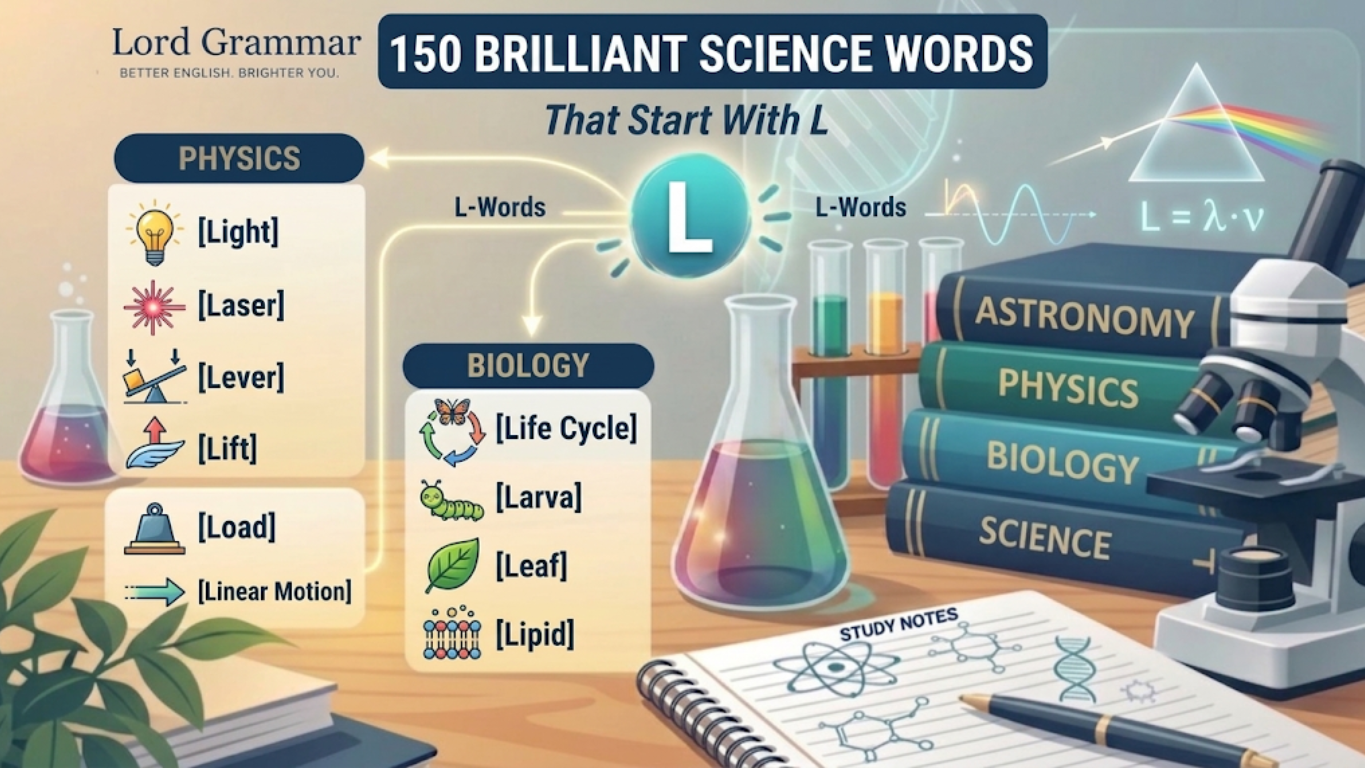
Science helps us understand the world around us. It explains how light travels, how living things grow, how chemicals react, and how planets move through space. Learning scientific words makes these ideas easier to understand.
This guide to science words that start with L covers physics, chemistry, biology, genetics, Earth science, astronomy, medicine, ecology, mathematics, and laboratory science. You will find familiar terms like light, laser, and liquid, as well as scientific terms such as luminosity, lithosphere, and lymphocyte.
Each word includes its origin, a simple meaning, and an example sentence to help you understand how it is used.
Physics Words That Start With L
Physics studies matter, energy, motion, and forces. These science words that start with L explain how objects move and how energy behaves.
| Word | Origin | Meaning | Example Sentence |
|---|---|---|---|
| Light | Old English | Energy that allows us to see. | Light entered the room through the window. |
| Laser | Acronym formed from English words | A device that produces a narrow, focused beam of light. | The laser cut through the thin material. |
| Lever | Old French | A simple machine that helps move a load around a turning point. | The lever helped lift the heavy stone. |
| Lift | Old Norse and English | An upward force that can help an object rise through a fluid. | Air flowing over the wing helped create lift. |
| Load | Old English | A weight or force placed on a structure or machine. | The bridge safely supported the load. |
| Linear motion | Latin | Movement along a straight line. | The cart showed linear motion along the track. |
| Linear momentum | Latin | The product of an object’s mass and velocity. | The moving truck had considerable linear momentum. |
| Longitudinal wave | Latin | A wave in which particles vibrate in the direction the wave travels. | Sound travels through air as a longitudinal wave. |
| Lateral force | Latin | A force acting sideways relative to an object or direction. | The turn created a lateral force on the vehicle. |
| Lorentz force | Named after Hendrik Lorentz | The force on a charged particle moving in electric and magnetic fields. | The Lorentz force changed the particle’s path. |
| Lenz’s law | Named after Heinrich Lenz | A law stating that induced current opposes the change that produces it. | Lenz’s law helped explain the current in the coil. |
| Latent heat | Latin | Energy absorbed or released during a change of state without a temperature change. | Ice absorbs latent heat as it melts. |
| Luminous intensity | Latin | A measure of light emitted in a particular direction. | The instrument measured the lamp’s luminous intensity. |
| Luminance | Latin | A measure of the brightness of a surface in a given direction. | The screen’s luminance was easy to measure. |
| Lux | Latin | The SI unit used to measure illuminance. | The sensor recorded 300 lux on the desk. |
Chemistry Words That Start With L
Chemistry studies substances, their properties, and how they change. These science words that start with L include elements, chemical bonds, and laboratory concepts.
| Word | Origin | Meaning | Example Sentence |
|---|---|---|---|
| Lithium | Greek | A soft, light metal with the chemical symbol Li. | Lithium is used in many rechargeable batteries. |
| Lanthanum | Greek | A metallic element with the symbol La. | Lanthanum is used in some optical materials. |
| Lawrencium | Named after Ernest Lawrence | A synthetic chemical element with the symbol Lr. | Scientists study lawrencium in nuclear research. |
| Lanthanides | Named after lanthanum | A series of metallic elements in the periodic table. | Lanthanides are important in several electronic technologies. |
| Ligand | Latin | An atom or molecule that binds to a central metal atom or ion. | The ligand bonded to the metal ion. |
| Lattice | French and Latin roots | An ordered arrangement of particles in a solid. | The salt crystal formed a regular lattice. |
| Lattice energy | Chemistry terminology | Energy associated with forming an ionic solid from gaseous ions, or separating it into those ions. | The class compared the lattice energy of ionic compounds. |
| Lewis acid | Named after Gilbert N. Lewis | A substance that accepts an electron pair. | The Lewis acid accepted an electron pair. |
| Lewis base | Named after Gilbert N. Lewis | A substance that donates an electron pair. | Ammonia can act as a Lewis base. |
| Lewis structure | Named after Gilbert N. Lewis | A diagram showing bonds and valence electrons in a molecule. | The student drew a Lewis structure for water. |
| Limiting reagent | Latin and French roots | The reactant that runs out first in a chemical reaction. | The limiting reagent controlled how much product formed. |
| Litmus | Scandinavian language roots | A dye used to test whether a substance is acidic or basic. | Blue litmus turned red in the acidic solution. |
| Leaching | English | The removal of substances from a material by a flowing liquid. | Rainwater caused leaching of minerals from the soil. |
| Liquefaction | Latin | The process of turning a substance into a liquid. | Cooling and pressure helped cause gas liquefaction. |
| London dispersion forces | Named after Fritz London | Weak attractions caused by temporary changes in electron distribution. | London dispersion forces help attract neighboring molecules. |
Biology Words That Start With L
Biology explores living things, from tiny cells to large animals. These science words that start with L describe organisms, body structures, and life processes.
| Word | Origin | Meaning | Example Sentence |
|---|---|---|---|
| Life cycle | Old English and Greek roots | The stages an organism passes through as it grows and reproduces. | A butterfly has a life cycle with several stages. |
| Larva | Latin | An early life stage of many animals, especially insects. | The larva fed on the leaves. |
| Leaf | Old English | A plant part that often captures sunlight for photosynthesis. | The leaf used sunlight to make food. |
| Lichen | Greek | An association between a fungus and a photosynthetic partner, usually an alga or cyanobacterium. | Lichen grew on the surface of the rock. |
| Ligament | Latin | Strong connective tissue that joins bones at a joint. | The ligament helped stabilize the knee. |
| Lipid | Greek | A group of biological molecules that includes fats and oils. | The body stores energy in lipid molecules. |
| Lipase | Greek | An enzyme that breaks down fats. | Lipase helped digest fat in the food. |
| Lactase | Latin | An enzyme that breaks down the milk sugar lactose. | Lactase helps the body digest lactose. |
| Lactose | Latin | The sugar naturally found in milk. | Lactose provides energy when it is digested. |
| Leucine | Greek | An essential amino acid used to build proteins. | Leucine is part of many proteins in the body. |
| Leukocyte | Greek | A white blood cell that helps defend the body. | A leukocyte moved toward the site of infection. |
| Lymph | Latin | Fluid that travels through the lymphatic system. | Lymph carries immune cells through the body. |
| Lymphocyte | Greek | A type of white blood cell involved in immune defense. | A lymphocyte helped the body respond to infection. |
| Locomotion | Latin | The movement of an organism from one place to another. | Fish use fins to help with locomotion. |
| Lineage | French and Latin roots | A line of descent from an ancestor. | The researchers traced the lineage of the species. |
Cell Biology and Genetics Words That Start With L
Cells contain structures and molecules that keep living things working. These science words that start with L explain cell parts, genetic information, and molecular processes.
| Word | Origin | Meaning | Example Sentence |
|---|---|---|---|
| Lysosome | Greek | A cell structure that breaks down waste and worn-out parts. | The lysosome helped recycle damaged cell parts. |
| Lysis | Greek | The breaking open or destruction of a cell. | The virus caused lysis of the infected cells. |
| Lysogenic cycle | Greek | A viral cycle in which viral genetic material remains in a host cell before active replication. | The virus entered the lysogenic cycle. |
| Lysogenic | Greek | Related to a process or state linked to the lysogenic cycle. | The scientist studied a lysogenic virus. |
| Locus | Latin | The position of a gene or DNA sequence on a chromosome. | The gene was found at a specific locus. |
| Loci | Latin | The plural form of locus. | Researchers compared several loci on the chromosomes. |
| Linkage | English genetics terminology | The tendency of nearby genes on a chromosome to be inherited together. | Genetic linkage helped explain the inherited traits. |
| Linkage map | English genetics terminology | A map showing the relative positions of genes based on inheritance patterns. | The team created a linkage map of the chromosome. |
| Ligase | Latin | An enzyme that joins molecules, often by forming a chemical bond. | DNA ligase joined the DNA fragments. |
| Ligation | Latin | The process of joining molecules or biological structures. | The experiment used DNA ligation to join fragments. |
| Long noncoding RNA | Molecular biology terminology | An RNA molecule that does not code for a protein and is typically longer than 200 nucleotides. | Long noncoding RNA can help regulate gene activity. |
| Leader sequence | English molecular biology terminology | A stretch of nucleic acid near the beginning of a gene transcript or messenger RNA. | The leader sequence affected how the RNA was used. |
| Lagging strand | English molecular biology terminology | The DNA strand made in short sections during DNA replication. | The lagging strand was built in small fragments. |
| Leading strand | English molecular biology terminology | The DNA strand made continuously during DNA replication. | The leading strand grew as the replication fork moved. |
| Liposome | Greek | A tiny bubble made from a lipid membrane. | The researchers used a liposome to carry a substance. |
Earth Science Words That Start With L
Earth science studies rocks, soil, landforms, and the processes that shape our planet. These science words that start with L describe Earth’s layers and natural materials.
| Word | Origin | Meaning | Example Sentence |
|---|---|---|---|
| Lithosphere | Greek | Earth’s rigid outer layer, including the crust and uppermost mantle. | The lithosphere is divided into moving plates. |
| Lithology | Greek | The study or description of rocks and their physical features. | Lithology helped identify the rock sample. |
| Lithification | Greek | The process by which loose sediment becomes solid rock. | Lithification turned the sediment into sandstone. |
| Lithosphere plate | Greek and English | A large, rigid piece of Earth’s outer shell. | A lithosphere plate moved slowly over geological time. |
| Lava | Italian | Molten rock that reaches Earth’s surface. | Lava flowed down the volcano’s slope. |
| Lapilli | Italian | Small pieces of volcanic material thrown out during an eruption. | Lapilli covered the ground near the volcano. |
| Loess | German | Fine wind-blown sediment, often rich in silt. | Loess formed a deep layer of fertile soil. |
| Laterite | Latin | Soil or rock rich in iron and aluminum oxides, often formed in warm, wet climates. | Laterite developed under strong weathering. |
| Landslide | English | The movement of rock, soil, or debris down a slope. | Heavy rain triggered a landslide. |
| Lacustrine | Latin | Related to lakes or deposits formed in lakes. | The geologist examined lacustrine sediment. |
| Lagoon | Italian and Latin roots | A shallow body of water separated partly from a larger body by a barrier. | The lagoon supported many coastal species. |
| Limestone | English | A sedimentary rock made mainly of calcium carbonate. | Limestone can dissolve in slightly acidic water. |
| Loam | Old English | Soil containing a balanced mixture of sand, silt, and clay. | Loam is useful for growing many garden plants. |
| Levee | French | A raised bank that helps hold back water. | The levee helped protect the town from flooding. |
| Lahar | Indonesian | A fast-moving mixture of volcanic debris and water. | The warning system detected a possible lahar. |
Astronomy Words That Start With L
Astronomy explores stars, planets, galaxies, and the wider universe. These science words that start with L help describe objects and events beyond Earth.
| Word | Origin | Meaning | Example Sentence |
|---|---|---|---|
| Light-year | English scientific terminology | The distance light travels in one year. | The star lies several light-years from Earth. |
| Luminosity | Latin | The total energy an object emits per second as radiation. | Astronomers estimated the star’s luminosity. |
| Lunar | Latin | Related to the Moon. | The spacecraft collected lunar surface images. |
| Lunar eclipse | Latin | An event in which Earth blocks sunlight from reaching the Moon directly. | We watched the lunar eclipse at night. |
| Lunar maria | Latin | Large, dark plains on the Moon formed mainly by ancient volcanic activity. | The lunar maria look dark in telescope images. |
| Lagrange point | Named after Joseph-Louis Lagrange | A location where gravitational and orbital effects allow a small object to maintain a useful position relative to two larger bodies. | A space telescope can operate near a Lagrange point. |
| Light curve | English astronomy terminology | A graph showing how an object’s brightness changes over time. | The light curve revealed changes in the star’s brightness. |
| Limb | Latin | The apparent edge of the disk of a celestial object. | The Sun’s limb was visible in the image. |
| Local Group | English astronomy terminology | The group of galaxies that includes the Milky Way and Andromeda. | The Milky Way belongs to the Local Group. |
| Lenticular galaxy | Latin | A galaxy with a disk and central bulge but no clear spiral arms. | The telescope captured a lenticular galaxy. |
| Lyman series | Named after Theodore Lyman | A set of hydrogen spectral lines produced by transitions to its lowest energy level. | The instrument detected a line from the Lyman series. |
| Lyman-alpha radiation | Named after Theodore Lyman | Ultraviolet radiation from a particular transition in hydrogen. | Astronomers measured Lyman-alpha radiation from the distant object. |
| Luminous red nova | Astronomy terminology | A stellar outburst that can occur when stars interact or merge. | The observatory studied a luminous red nova. |
| Low Earth orbit | English aerospace terminology | An orbit relatively close to Earth, commonly used by satellites and crewed spacecraft. | The satellite traveled in low Earth orbit. |
| Lunar regolith | Latin and Greek roots | The loose layer of dust and broken rock covering the Moon’s surface. | The lander examined lunar regolith. |
Medical Science Words That Start With L
Medical science studies the human body and the conditions that affect it. These science words that start with L describe organs, tissues, and medical terms.
| Word | Origin | Meaning | Example Sentence |
|---|---|---|---|
| Liver | Old English | An organ that processes nutrients and helps remove harmful substances from the blood. | The liver helps process nutrients after a meal. |
| Lung | Old English | An organ that takes oxygen into the body and removes carbon dioxide. | The lung expands when a person breathes in. |
| Larynx | Greek | The structure in the throat that contains the vocal cords. | The larynx helps produce the voice. |
| Laryngeal | Greek | Related to the larynx. | The doctor examined the laryngeal tissue. |
| Lymph node | Latin | A small structure that filters lymph and supports immune responses. | The lymph node became swollen during the infection. |
| Lymphatic system | Latin | A network that moves lymph and supports immune function. | The lymphatic system helps defend the body. |
| Lesion | Latin | An area of damaged or abnormal tissue. | The scan showed a small lesion. |
| Leukemia | Greek | A group of cancers that affect blood-forming tissues and blood cells. | The specialist explained how leukemia affects blood cells. |
| Leukopenia | Greek | A lower-than-normal number of white blood cells. | The blood test showed leukopenia. |
| Lordosis | Greek | An inward curve of the spine, especially in the lower back. | The clinician assessed the patient’s spinal lordosis. |
| Laparoscopy | Greek | A procedure that uses a small camera to examine or operate inside the abdomen. | The surgeon used laparoscopy during the procedure. |
| Laryngitis | Greek | Inflammation of the larynx. | Laryngitis made the person’s voice hoarse. |
| Lactation | Latin | The production of milk by the mammary glands. | Lactation provides milk for a newborn. |
| Lipoma | Greek | A usually benign growth made of fatty tissue. | The doctor examined the small lipoma. |
| Lumbar vertebra | Latin | One of the vertebrae in the lower part of the spine. | The lumbar vertebra supports much of the upper body’s weight. |
Ecology and Environmental Science Words That Start With L
Ecology studies how organisms interact with one another and their environment. These science words that start with L explain ecosystems, water, and environmental change.
| Word | Origin | Meaning | Example Sentence |
|---|---|---|---|
| Limnology | Greek | The study of inland waters, including lakes and rivers. | Limnology helps scientists understand lake ecosystems. |
| Littoral zone | Latin | The shallow area near the shore of a lake or sea. | Small fish lived in the littoral zone. |
| Lotic ecosystem | Latin | An ecosystem in flowing water, such as a river or stream. | Insects and fish lived in the lotic ecosystem. |
| Lentic ecosystem | Latin | An ecosystem in still or slowly moving water, such as a lake or pond. | Algae grew in the lentic ecosystem. |
| Leaching | English | The movement of dissolved substances through soil or rock with water. | Leaching carried nutrients deeper into the soil. |
| Land degradation | English | A decline in the quality or usefulness of land. | Deforestation can contribute to land degradation. |
| Land use | English | The way people manage or develop an area of land. | Satellite images helped track changes in land use. |
| Land cover | English | The physical material covering Earth’s surface, such as forests or water. | The map showed forest as the main land cover. |
| Limiting factor | English ecological terminology | A condition or resource that restricts growth or population size. | Water became the limiting factor during the drought. |
| Logistic growth | Greek and English | Population growth that slows as resources become limited. | The population followed a logistic growth pattern. |
| Litter layer | English ecological terminology | The surface layer of dead leaves and other plant material on the ground. | Insects lived in the forest litter layer. |
| Leaf litter | English | Fallen leaves and plant remains on the soil surface. | Leaf litter returned nutrients to the soil. |
| Legume | Latin | A plant in the pea family, many of which host nitrogen-fixing bacteria. | The legume improved soil nitrogen levels. |
| Leptospirosis | Greek | A disease caused by bacteria that can spread through water or soil contaminated by infected animals. | Environmental testing helped assess the risk of leptospirosis. |
| Light pollution | English | Excessive or poorly directed artificial light at night. | Light pollution made faint stars harder to see. |
Mathematics and Engineering Words That Start With L
Mathematics and engineering help scientists measure, model, and build things. These science words that start with L are used in calculations, machines, and technical design.
| Word | Origin | Meaning | Example Sentence |
|---|---|---|---|
| Logarithm | Greek | The power to which a base must be raised to produce a number. | The student used a logarithm to solve the equation. |
| Limit | Latin | A value that a mathematical expression approaches. | The class calculated the limit of the function. |
| Linear equation | Latin | An equation whose graph is a straight line. | The student graphed the linear equation. |
| Linear function | Latin | A function that changes at a constant rate and has a straight-line graph in its standard form. | The data followed a linear function. |
| Least common multiple | English mathematical terminology | The smallest positive number that is a multiple of two or more whole numbers. | The class found the least common multiple of six and eight. |
| Least squares | English mathematical terminology | A method that fits a model by minimizing the sum of squared differences. | The engineer used least squares to fit the measurements. |
| Laplace transform | Named after Pierre-Simon Laplace | A mathematical method used to turn certain differential equations into simpler equations. | The Laplace transform helped solve the circuit problem. |
| Lagrange multiplier | Named after Joseph-Louis Lagrange | A method for solving optimization problems with constraints. | The researcher used a Lagrange multiplier to optimize the model. |
| Lattice graph | Mathematics terminology | A graph arranged in a regular grid-like pattern. | The computer displayed the lattice graph. |
| Logic gate | English computing terminology | An electronic circuit that performs a basic logical operation. | The logic gate processed the binary input. |
| Load balancing | English computing and engineering terminology | The distribution of work across multiple systems or components. | Load balancing helped the server handle more requests. |
| Linear programming | Latin and English | A method for optimizing a goal under linear constraints. | Linear programming helped plan the factory schedule. |
| Link budget | English engineering terminology | A calculation of signal power and losses across a communication link. | The engineer checked the link budget before testing the radio. |
| Loss function | English mathematics and computing terminology | A measure of how far a model’s prediction is from the desired result. | The training process reduced the loss function. |
| Low-pass filter | English electrical engineering terminology | A filter that allows lower-frequency signals through while reducing higher-frequency signals. | The low-pass filter removed high-frequency noise. |
Laboratory and Materials Science Words That Start With L
Scientists use laboratory methods and material tests to study substances and develop new technologies. These science words that start with L describe tools, properties, and processes.
| Word | Origin | Meaning | Example Sentence |
|---|---|---|---|
| Laboratory | Medieval Latin | A place where scientific tests and experiments are carried out. | The students performed the experiment in the laboratory. |
| Labile | Latin | Easily changed, broken down, or replaced under certain conditions. | The labile compound changed when heated. |
| Laminar flow | Latin | Smooth fluid flow in layers with little mixing between them. | The fluid moved through the tube in laminar flow. |
| Lamella | Latin | A thin plate-like layer or structure. | The material contained a thin lamella. |
| Lamellar structure | Latin | A structure made of thin layers or plates. | The microscope revealed a lamellar structure. |
| Lap joint | English engineering terminology | A joint in which two pieces overlap. | The metal sheets were connected with a lap joint. |
| Laser ablation | English scientific terminology | The removal of material using a laser. | Laser ablation removed a thin surface layer. |
| Laser spectroscopy | English scientific terminology | The study of matter using the interaction between laser light and a sample. | Laser spectroscopy helped identify the substance. |
| Light microscopy | English scientific terminology | The use of visible light and lenses to view small objects. | Light microscopy revealed the cells. |
| Liquid crystal | English scientific terminology | A material that flows like a liquid but has some ordered molecular properties of a crystal. | The display used a liquid crystal. |
| Liquid chromatography | Greek and English scientific terminology | A method for separating substances in a liquid sample. | Liquid chromatography separated the mixture’s components. |
| Liquid nitrogen | English chemical terminology | Nitrogen cooled until it becomes a liquid at very low temperature. | The researcher used liquid nitrogen to cool the sample. |
| Loss modulus | English materials science terminology | A measure of energy lost as heat during the deformation of a material. | The test measured the polymer’s loss modulus. |
| Long-term stability | English scientific terminology | The ability of a material or system to remain consistent over time. | The team tested the sensor’s long-term stability. |
| Lattice defect | English materials science terminology | A disruption in the regular arrangement of particles in a crystal. | The crystal contained a lattice defect. |
Conclusion
These science words that start with L cover a wide range of scientific subjects, from physics and chemistry to biology, astronomy, and engineering. Words such as laser, lithosphere, lymphocyte, and luminosity help describe important ideas about matter, life, Earth, and space.
To remember these terms, read their meanings, study the example sentences, and try using a few in your own writing. Learning scientific vocabulary step by step can make school lessons and science articles easier to understand.
Frequently Asked Questions
What are some common science words that start with L?
Common examples include light, laser, liquid, lever, lava, leaf, lipid, liver, and laboratory. These words appear in several areas of science.
What are some biology words that start with L?
Biology terms include larva, lichen, ligament, lipid, lipase, lactase, leukocyte, lymphocyte, lysosome, and locus. They describe living things, cells, and biological processes.
Which chemistry words start with L?
Chemistry words include lithium, lanthanum, lawrencium, ligand, lattice, litmus, Lewis acid, Lewis base, and limiting reagent.
What does light-year mean in science?
A light-year is a unit of distance, not time. It measures how far light travels in one year, which is about 9.46 trillion kilometers.
What is the lithosphere?
The lithosphere is Earth’s rigid outer layer. It includes the crust and the uppermost part of the mantle and is divided into tectonic plates.
What is a laser used for?
A laser produces a narrow, focused beam of light. Lasers are used in medicine, manufacturing, communication, research, and scientific measurement.
What are some astronomy words that start with L?
Examples include light-year, luminosity, lunar eclipse, Lagrange point, light curve, Local Group, and lunar regolith.
Why should students learn science words that start with L?
Learning these words helps students understand textbooks, explain scientific ideas, prepare for exams, and build stronger science vocabulary.
Where can I find reliable definitions of astronomy terms?
NASA provides an authoritative Universe Glossary with definitions of astronomy terms and concepts.