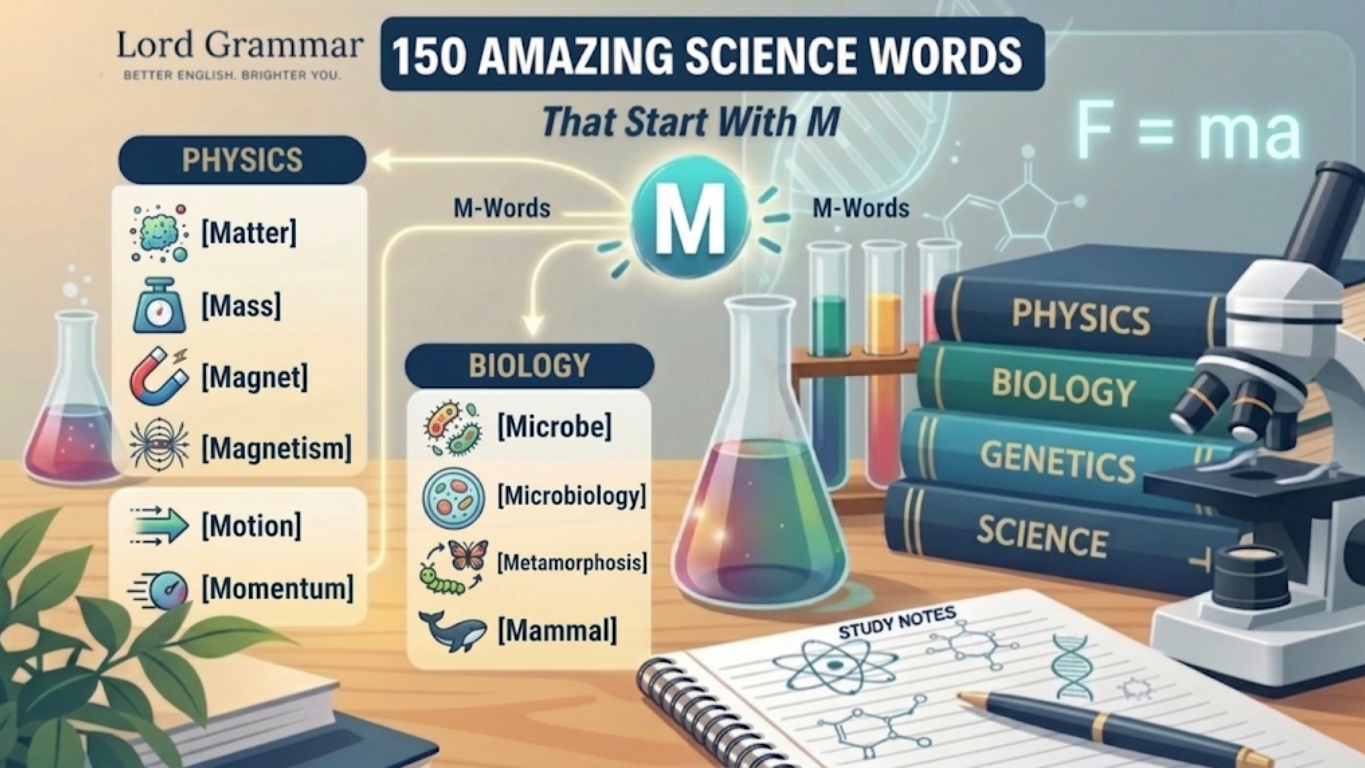
Science words that start with M help explain how the world works, from tiny molecules to massive galaxies. These terms appear in biology, chemistry, physics, Earth science, medicine, and engineering.
This guide brings together 150 science words that start with M. Each term includes its origin, a simple definition, and an example sentence to help students understand and use it correctly.
Physics Words That Start With M
Physics studies matter, energy, forces, and motion. These science words that start with M explain important ideas about how objects and energy behave.
| Word | Origin | Meaning | Example Sentence |
|---|---|---|---|
| Matter | Latin materia | Anything that has mass and takes up space | Air is matter because it has mass and takes up space. |
| Mass | Greek maza, through Latin | The amount of matter in an object | The rock has more mass than the pebble. |
| Magnet | Greek magnētis lithos | An object that attracts certain magnetic materials | The magnet picked up an iron nail. |
| Magnetism | Greek magnētis lithos | A force linked to magnets and moving electric charges | Magnetism makes a compass needle turn. |
| Magnetic Field | Greek and English | The region where magnetic forces can act | Earth has a magnetic field around it. |
| Magnetic Force | Greek and Latin roots | A push or pull caused by magnetism | Magnetic force pulled the paper clip toward the magnet. |
| Mechanics | Greek mēkhanikē | The study of motion and forces | Mechanics helps explain how a bicycle moves. |
| Motion | Latin motio | A change in position over time | The motion of the ball slowed down. |
| Momentum | Latin momentum | A measure of an object’s motion based on its mass and velocity | A moving truck has more momentum than a slow-moving toy car of the same direction. |
| Mechanical Energy | Greek mēkhanē and energeia | Energy related to an object’s motion or position | A swinging pendulum has mechanical energy. |
| Mass Density | Latin massa and Greek densitas | The amount of mass in a given volume | The mass density of the metal was higher than that of the wood. |
| Moment of Inertia | Latin momentum and inertia | A measure of how much an object resists changes in rotation | A wide wheel can have a large moment of inertia. |
| Microwave | English, from micro and wave | An electromagnetic wave with a short wavelength | A microwave signal can carry information. |
| Microgravity | Greek mikros and Latin gravitas | A condition in which objects appear to experience very little weight | Astronauts float in the microgravity of an orbiting spacecraft. |
| Molecular Motion | Latin molecula and motio | The movement of molecules | Heating a liquid increases molecular motion. |
Chemistry Words That Start With M
Chemistry explores substances, their properties, and how they change. These science words that start with M cover atoms, solutions, and chemical materials.
| Word | Origin | Meaning | Example Sentence |
|---|---|---|---|
| Molecule | Latin molecula | Two or more atoms joined by chemical bonds | A water molecule contains hydrogen and oxygen atoms. |
| Mixture | Latin mixtura | Two or more substances combined without forming a new chemical substance | Lemonade is a mixture of water, sugar, and lemon juice. |
| Metal | Greek metallon | An element that often conducts heat and electricity well | Copper is a useful metal for electrical wires. |
| Metalloid | Greek metallon and -oeidēs | An element with properties of both metals and nonmetals | Silicon is a metalloid used in computer chips. |
| Mineral | Medieval Latin minerale | A naturally occurring solid with a defined chemical composition and structure | Quartz is a common mineral. |
| Molarity | Latin molaris | The number of moles of dissolved substance per liter of solution | The student calculated the molarity of the salt solution. |
| Mole | German Mol | A unit for measuring the amount of a substance | A mole represents a fixed number of particles. |
| Molar Mass | Latin molaris and massa | The mass of one mole of a substance | The molar mass of water is about 18 grams per mole. |
| Melting Point | Old English melt and point | The temperature at which a solid becomes a liquid | Ice melts at about zero degrees Celsius under normal pressure. |
| Miscibility | Latin miscere | The ability of liquids to mix evenly | Scientists tested the miscibility of two liquids. |
| Miscible | Latin miscere | Able to mix evenly with another liquid | Water and ethanol are miscible. |
| Methane | French méthane | A gas made of carbon and hydrogen, with the formula CH₄ | Methane can be released from wetlands. |
| Methyl Group | Greek-derived methyl | A chemical group containing one carbon and three hydrogen atoms | A methyl group is found in many organic compounds. |
| Methylene Group | Greek-derived methylene | A chemical group containing one carbon bonded to two hydrogen atoms | A methylene group forms part of many organic molecules. |
| Metabolite | Greek metabolē | A substance made or used during chemical processes in an organism | Glucose is an important metabolite in cells. |
Biology Words That Start With M
Biology studies living things and how they survive, grow, and reproduce. These science words that start with M introduce organisms, life processes, and the natural world.
| Word | Origin | Meaning | Example Sentence |
|---|---|---|---|
| Microbe | Greek mikros and bios | A tiny organism or biological agent, often studied with a microscope | Some microbes live in soil and help break down dead plants. |
| Microorganism | Greek mikros and organismos | An organism too small to see clearly without magnification | Yeast is a microorganism used in baking. |
| Microbiology | Greek mikros, bios, and logos | The study of microorganisms | Microbiology helps scientists study bacteria. |
| Microbiome | Greek mikros and biōma | A community of microorganisms living in a particular place | The gut microbiome includes many kinds of microbes. |
| Microhabitat | Greek mikros and habitat | A small, specific place where an organism lives | A rotting log can be a microhabitat for insects. |
| Migration | Latin migratio | Movement from one region to another, often at a regular time | Bird migration often follows seasonal changes. |
| Mimicry | Greek mimikos | A feature that helps an organism resemble another organism or its surroundings | Some flies use mimicry to look like wasps. |
| Mutation | Latin mutatio | A change in genetic material | A mutation can affect the color of a flower. |
| Mycelium | Greek mykēs | A network of fine threads that forms much of a fungus | Mycelium spreads through the soil beneath a mushroom. |
| Mycology | Greek mykēs and logos | The study of fungi | Mycology helps researchers identify different fungi. |
| Mycorrhiza | Greek mykēs and rhiza | An association between a fungus and a plant’s roots | Mycorrhiza can help plant roots absorb nutrients. |
| Mollusk | Latin molluscus | An animal in a group that includes snails, clams, and octopuses | An octopus is a mollusk. |
| Metamorphosis | Greek meta and morphē | A major change in an animal’s body during development | A caterpillar undergoes metamorphosis to become a butterfly. |
| Mammal | Latin mamma | An animal group whose females produce milk for their young | A whale is a mammal. |
| Mutualism | Latin mutuus | An interaction in which both organisms benefit | Bees and flowering plants can benefit from mutualism. |
Cell Biology and Genetics Words That Start With M
Cells and genes explain how living things grow and pass traits to offspring. These science words that start with M focus on cell structures and genetic processes.
| Word | Origin | Meaning | Example Sentence |
|---|---|---|---|
| Membrane | Latin membrana | A thin layer that covers or separates parts of a cell | The cell membrane controls what enters and leaves the cell. |
| Mitochondrion | Greek mitos and chondrion | A cell structure that helps release usable energy from food | A mitochondrion helps a cell produce energy. |
| Mitosis | Greek mitos | Cell division that usually produces two genetically similar daughter cells | Mitosis helps the body replace damaged skin cells. |
| Meiosis | Greek meiōsis | Cell division that reduces chromosome number to form reproductive cells | Meiosis helps produce sperm and egg cells. |
| Messenger RNA | English and ribonucleic acid | A molecule that carries genetic instructions used to make proteins | Messenger RNA carries instructions to the cell’s protein-making machinery. |
| MicroRNA | English and ribonucleic acid | A small RNA molecule that helps regulate gene activity | MicroRNA can affect how much of a protein a cell makes. |
| Microsatellite | Greek mikros and Latin satelles | A short DNA sequence repeated several times | Scientists can examine a microsatellite when comparing DNA samples. |
| Methylation | Greek-derived methyl | The addition of a methyl group to a molecule | DNA methylation can help regulate gene activity. |
| Mendelian Inheritance | Named after Gregor Mendel | The passing of traits according to patterns described by Mendel | Mendelian inheritance explains some inherited traits. |
| Monohybrid Cross | Greek monos and English hybrid | A genetic cross that examines one trait | A monohybrid cross can show how a flower-color trait is inherited. |
| Multiple Alleles | Latin multiplex and Greek allelon | More than two possible forms of a gene within a population | The ABO blood group system involves multiple alleles. |
| Monosomy | Greek monos and sōma | A condition in which a cell has one copy of a chromosome instead of the usual pair | Monosomy can affect growth and development. |
| Mosaicism | From mosaic | A condition in which one individual has groups of cells with different genetic makeup | Mosaicism can cause some cells to have different chromosome patterns. |
| Macromolecule | Greek makros and Latin molecula | A large molecule made of many atoms | DNA is a biological macromolecule. |
| Microtubule | Greek mikros and Latin tubulus | A tiny tube-like structure that supports cells and helps move cell parts | Microtubules help separate chromosomes during cell division. |
Earth Science Words That Start With M
Earth science explores the planet’s rocks, land, oceans, and atmosphere. These science words that start with M help explain geological materials and natural processes.
| Word | Origin | Meaning | Example Sentence |
|---|---|---|---|
| Mantle | From Latin mantellum | The layer of Earth between the crust and the core | Earth’s mantle lies beneath the crust. |
| Magma | Greek magma | Melted or partly melted rock beneath Earth’s surface | Magma can rise through cracks in Earth’s crust. |
| Magma Chamber | Greek magma and English chamber | An underground area where magma collects | Scientists study how a magma chamber changes before an eruption. |
| Metamorphic Rock | Greek meta and morphē | Rock changed by heat, pressure, or fluids | Marble is a metamorphic rock. |
| Metamorphism | Greek meta and morphē | The process that changes rock without fully melting it | Metamorphism can turn shale into slate. |
| Mineralogy | Latin minerale and Greek logos | The study of minerals | Mineralogy helps scientists identify rocks and crystals. |
| Mohs Scale | Named after Friedrich Mohs | A scale that ranks minerals by their scratch hardness | Diamond ranks highest on the Mohs scale. |
| Moraine | French, from a regional Alpine term | Rock and soil left behind by a glacier | The glacier left a moraine at the edge of the valley. |
| Monsoon | Portuguese monção, from Arabic mawsim | A seasonal wind pattern that often brings heavy rain | The summer monsoon brings rain to many parts of South Asia. |
| Mantle Plume | English geological term | A rising column of unusually hot material in Earth’s mantle | A mantle plume may help form a volcanic island. |
| Marine Geology | Latin mare and Greek geōlogia | The study of the geology of ocean floors and coastal areas | Marine geology helps explain how ocean basins form. |
| Mudstone | English compound | A fine-grained sedimentary rock made mainly from mud-sized particles | The cliff contains layers of mudstone. |
| Mass Wasting | English geological term | The downhill movement of soil and rock under gravity | Heavy rain can trigger mass wasting on a steep slope. |
| Mesosphere | Greek mesos and sphaira | The atmospheric layer above the stratosphere and below the thermosphere | Many meteors burn up in the mesosphere. |
| Magnetometer | Greek magnētis and metron | An instrument that measures magnetic fields | A magnetometer can measure changes in Earth’s magnetic field. |
Astronomy Words That Start With M
Astronomy studies planets, stars, galaxies, and space. These science words that start with M introduce objects and processes that astronomers observe and investigate.
| Word | Origin | Meaning | Example Sentence |
|---|---|---|---|
| Milky Way | English name for the galaxy | The galaxy that contains our Solar System | The Milky Way contains billions of stars. |
| Moon | Old English mōna | A natural object that orbits a planet or another larger body | Earth’s Moon affects ocean tides. |
| Mars | Named after the Roman god of war | The fourth planet from the Sun | Scientists have sent robotic explorers to Mars. |
| Mercury | Named after the Roman messenger god | The planet closest to the Sun | Mercury completes an orbit around the Sun in about 88 Earth days. |
| Meteor | Greek meteōros | A streak of light produced when space material enters an atmosphere | We saw a bright meteor in the night sky. |
| Meteorite | Greek meteōros | Space material that survives its passage through an atmosphere and reaches the ground | Scientists studied the meteorite for clues about the early Solar System. |
| Meteoroid | Greek meteōros | A small natural object traveling through space | A meteoroid can create a meteor when it enters Earth’s atmosphere. |
| Magnetosphere | Greek magnētis and sphaira | The region around a planet or other body where its magnetic field affects charged particles | Earth’s magnetosphere helps deflect many charged particles from the Sun. |
| Main Sequence | English astronomical term | The stage when a star spends most of its life fusing hydrogen in its core | The Sun is a main-sequence star. |
| Magnitude | Latin magnitudo | A numerical measure used to describe an object’s brightness in astronomy | Astronomers compare the magnitude of stars to study their brightness. |
| Messier Object | Named after Charles Messier | An object listed in a catalog of galaxies, star clusters, and nebulae | The Andromeda Galaxy is a Messier object. |
| Molecular Cloud | Latin molecula and English cloud | A cold cloud of gas and dust where stars may form | New stars can form inside a molecular cloud. |
| Multiverse | Latin multus and universum | A hypothetical collection of multiple universes | The multiverse is a theoretical idea, not an established observation. |
| Microlensing | Greek mikros and English lens | A change in light caused when gravity bends light from a distant object | Astronomers use microlensing to search for distant planets. |
| Magnetar | English scientific term based on magnetic and star | A neutron star with an extremely strong magnetic field | A magnetar can release powerful bursts of energy. |
Medical Science Words That Start With M
Medical science examines the human body, health, and disease. These science words that start with M explain body structures, substances, and medical concepts.
| Word | Origin | Meaning | Example Sentence |
|---|---|---|---|
| Metabolism | Greek metabolē | The chemical processes that help the body use energy and maintain life | Metabolism helps the body use nutrients from food. |
| Melatonin | Name formed from melanin and related chemical naming | A hormone that helps regulate the sleep-wake cycle | Melatonin levels usually rise in the evening. |
| Melanocyte | Greek melas and kytos | A cell that produces the pigment melanin | A melanocyte makes pigment that helps give skin its color. |
| Melanin | Greek melas | A pigment that gives color to skin, hair, and eyes | Melanin helps protect skin from some ultraviolet radiation. |
| Mucus | Latin mucus | A slippery substance that protects and moistens body surfaces | Mucus helps trap dust in the nose. |
| Mucosa | Latin mucosus | A moist tissue lining certain body passages and organs | The stomach mucosa helps protect the stomach wall. |
| Myocardium | Greek mys and kardia | The muscular tissue of the heart | The myocardium contracts to pump blood. |
| Myopia | Greek myōps | Nearsightedness, a vision condition in which distant objects look blurry | A person with myopia may need glasses to see the board clearly. |
| Myelin | Greek myelos | A fatty insulating layer around many nerve fibers | Myelin helps nerve signals travel quickly. |
| Meninges | Greek mēninx | The protective membranes around the brain and spinal cord | The meninges surround the brain and spinal cord. |
| Metastasis | Greek meta and stasis | The spread of cancer cells from one part of the body to another | Metastasis can cause cancer to affect other organs. |
| Myalgia | Greek mys and algos | Muscle pain | The patient reported myalgia after strenuous exercise. |
| Myocardial Infarction | Greek mys, kardia, and Latin infarctus | Damage to heart muscle caused by a blocked blood supply; commonly called a heart attack | A myocardial infarction requires urgent medical care. |
| Menopause | Greek mēn and pausis | The stage when menstrual periods stop permanently | Menopause is a natural stage of aging. |
| Mydriasis | Greek mydriasis | Enlargement of the pupil of the eye | The doctor checked the patient’s pupil for mydriasis. |
Ecology and Environmental Science Words That Start With M
Ecology studies how organisms interact with one another and their surroundings. These science words that start with M cover habitats, pollution, resources, and environmental change.
| Word | Origin | Meaning | Example Sentence |
|---|---|---|---|
| Microclimate | Greek mikros and klima | The climate of a small area that may differ from nearby places | Shade from a tree can create a cooler microclimate. |
| Mangrove | Portuguese mangue and English grove | A salt-tolerant tree or shrub that grows in coastal areas | Mangrove roots provide shelter for young fish. |
| Marsh | Old English mersc | Wet land often covered with grasses and shallow water | Frogs live in the marsh near the lake. |
| Meadow | Old English mǣdwe | An open area covered mainly with grasses and wild plants | Bees visited flowers across the meadow. |
| Microplastic | Greek mikros and English plastic | A very small piece of plastic, usually less than five millimeters long | Researchers study microplastic in rivers and oceans. |
| Methane Emissions | Greek-derived methane and Latin emittere | Methane gas released into the atmosphere | Reducing methane emissions can help limit global warming. |
| Mitigation | Latin mitigare | Action taken to reduce the harm or severity of something | Planting trees can support climate change mitigation. |
| Monoculture | Greek monos and Latin cultura | Growing one type of crop over a large area | Monoculture farming can make crops more vulnerable to some pests. |
| Marine Ecosystem | Latin mare and Greek oikos | A community of organisms interacting in a saltwater environment | Coral reefs support a rich marine ecosystem. |
| Mineral Nutrient | Latin minerale and nutrire | An inorganic nutrient needed for growth | Plants absorb mineral nutrients from the soil. |
| Moisture | Latin musteus | Water present in the air, soil, or another material | Soil moisture affects how well a seed can grow. |
| Mesotrophic Lake | Greek mesos and trophē | A lake with a moderate supply of nutrients | A mesotrophic lake has a moderate level of plant growth. |
| Methanotroph | Greek-derived methane and trophē | A microorganism that uses methane as a source of carbon and energy | A methanotroph can consume methane in wetland soil. |
| Mycorrhizal Fungi | Greek mykēs and rhiza | Fungi that form close associations with plant roots | Mycorrhizal fungi can help plants absorb phosphorus. |
| Marine Debris | Latin mare and French débris | Human-made waste found in seas and coastal areas | Marine debris can harm turtles and seabirds. |
Mathematics and Engineering Words That Start With M
Mathematics and engineering help scientists measure, model, and build things. These science words that start with M are useful in calculations, technology, and practical experiments.
| Word | Origin | Meaning | Example Sentence |
|---|---|---|---|
| Measurement | Old French mesurement | The process of finding the size, amount, or value of something | Accurate measurement is important in a science experiment. |
| Metric System | Greek metron and Latin systema | A measurement system based on units such as meters and grams | Scientists often use the metric system to record results. |
| Meter | Greek metron | The standard metric unit of length | The table is one meter long. |
| Millimeter | Latin mille and Greek metron | One-thousandth of a meter | The insect was only a few millimeters long. |
| Micrometer (Unit) | Greek mikros and metron | A length unit equal to one-millionth of a meter | A cell may be measured in micrometers. |
| Mathematical Model | Greek mathēmatikē and Latin modulus | A mathematical description of a real system | A mathematical model can help predict a planet’s path. |
| Matrix | Latin matrix | A rectangular arrangement of numbers or other values | The engineer used a matrix to organize the calculations. |
| Modulus of Elasticity | Latin modulus and elasticus | A measure of how stiff a material is | The modulus of elasticity helps engineers compare materials. |
| Modulation | Latin modulatio | Changing a signal’s properties to carry information | Radio modulation helps transmit sound or data. |
| Microcontroller | Greek mikros and English controller | A small computer on a chip that controls a device | A microcontroller can control the lights in a science project. |
| Microprocessor | Greek mikros and English processor | An electronic chip that processes instructions | A microprocessor performs calculations in a computer. |
| Microfluidics | Greek mikros and Latin fluidus | The study and control of tiny amounts of fluid in small channels | Microfluidics can help researchers test tiny samples. |
| Mach Number | Named after physicist Ernst Mach | The ratio of an object’s speed to the local speed of sound | An aircraft at Mach 2 travels at twice the local speed of sound. |
| Mechanical Advantage | Greek mēkhanē and Latin-derived advantage | How much a machine multiplies an applied force | A lever can provide mechanical advantage. |
| Multiplexing | Latin multiplex | Combining several signals or data streams for transmission | Multiplexing allows one communication channel to carry several signals. |
Laboratory and Materials Science Words That Start With M
Laboratories use special tools and methods to test materials and study reactions. These science words that start with M introduce research equipment, material properties, and scientific methods.
| Word | Origin | Meaning | Example Sentence |
|---|---|---|---|
| Microscope | Greek mikros and skopein | An instrument that makes very small objects appear larger | The student used a microscope to view plant cells. |
| Microscopy | Greek mikros and skopein | The use or study of microscopes | Microscopy helped the team examine the sample. |
| Micropipette | Greek mikros and French pipette | A tool for measuring and transferring very small liquid volumes | The researcher used a micropipette to transfer a small amount of liquid. |
| Microbalance | Greek mikros and Latin bilanx | A very sensitive balance for measuring tiny masses | A microbalance measured the small sample. |
| Mass Spectrometry | Latin massa and Greek metron | A method for identifying substances by measuring the masses of ions | Mass spectrometry helped identify the unknown compound. |
| Magnetic Resonance | Greek magnētis and Latin resonare | A response that occurs when a system absorbs energy at a particular frequency in a magnetic field | Magnetic resonance is used in some medical imaging methods. |
| Materials Science | Latin materia and scientia | The study of the properties and uses of materials | Materials science helps engineers develop stronger products. |
| Metallurgy | Greek metallon and ergon | The science and technology of metals | Metallurgy helps explain how steel is made. |
| Microstructure | Greek mikros and Latin structura | The small-scale structure of a material | The metal’s microstructure affects its strength. |
| Malleability | Latin malleus | The ability of a material to be hammered or rolled into thin sheets | Gold has high malleability. |
| Magnetic Susceptibility | Greek magnētis and Latin susceptibilis | A measure of how a material responds to an applied magnetic field | Magnetic susceptibility helps scientists study a material’s magnetic response. |
| Membrane Filter | Latin membrana and English filter | A thin barrier that separates particles from a fluid | The lab used a membrane filter to remove tiny particles from water. |
| Moisture Content | Latin musteus and Latin contentum | The amount of water in a material | The team measured the moisture content of the soil. |
| Methodology | Greek methodos and logos | The methods used in a study or investigation | The report described the methodology used in the experiment. |
| Mass Spectrometer | Latin massa and Greek metron | An instrument that measures the mass-to-charge ratios of ions | The scientist used a mass spectrometer to analyze the sample. |
Conclusion
Learning science words that start with M can make science lessons easier to understand. These terms cover everything from matter, molecules, and mutations to meteorites, microplastics, and mathematical models.
As you study science words that start with M, try using each term in your own sentence. Connecting a definition to a real example can help you remember it and understand how it applies to the world around you.
For more reliable definitions, explore NASA’s M Science Glossary and NASA’s Picture Dictionary. These resources explain science terms related to space, matter, magnets, and other scientific topics.
Frequently Asked Questions
What are some common science words that start with M?
Common examples include matter, mass, molecule, magnetism, mutation, metabolism, mineral, mantle, meteor, and microscope.
What is a science word that starts with M in biology?
Mitosis is a biology term for cell division that usually produces two genetically similar daughter cells. Other examples include mutation, microbiome, and mycelium.
What are some chemistry words that start with M?
Chemistry terms include molecule, mixture, metal, metalloid, molarity, molar mass, methane, and melting point.
What are some astronomy words that start with M?
Examples include Mars, Mercury, meteor, meteorite, meteoroid, magnetosphere, magnetar, and Milky Way.
Why should students learn science words that start with M?
Learning science vocabulary helps students understand textbooks, follow lessons, describe experiments, and explain scientific ideas more clearly.