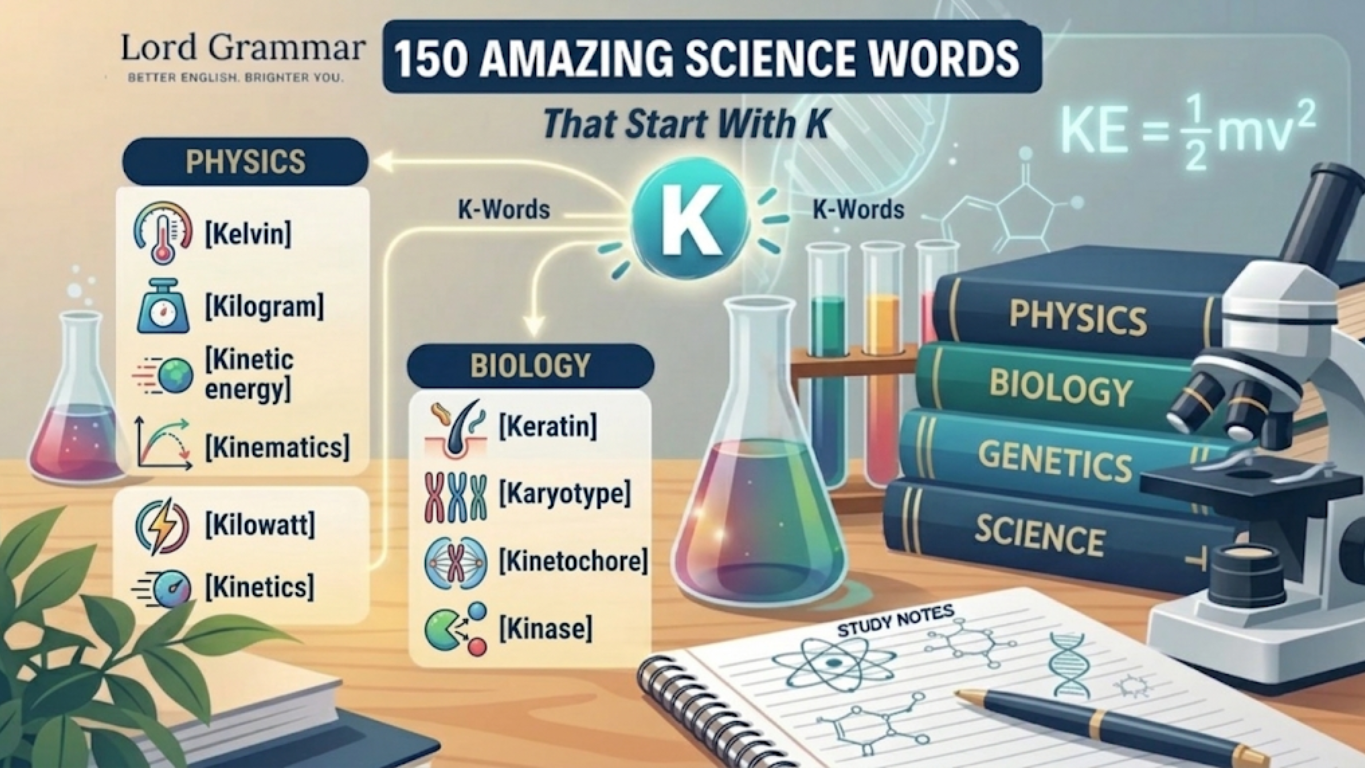
Science helps us understand how the world works, from tiny cells to distant stars. Learning new scientific words makes these ideas easier to explore. This guide to science words that start with K includes terms from physics, chemistry, biology, astronomy, earth science, medicine, and more.
Some words, such as kelvin and kilogram, describe measurements. Others, such as kinetic energy and karyotype, help explain movement and living things. Each term below includes its origin, a simple meaning, and an example sentence.
Physics and Measurement Words That Start With K
Physics explains motion, energy, forces, and measurements. These science words that start with K help describe how objects move and how scientists measure the world.
| Word | Origin | Meaning | Example Sentence |
|---|---|---|---|
| Kelvin | Named after Lord Kelvin | The SI unit used to measure temperature. | Scientists measured the gas temperature in kelvins. |
| Kilogram | French and Greek roots | The SI base unit of mass. | The package had a mass of one kilogram. |
| Kilometer | Greek roots | A unit of length equal to 1,000 meters. | The runner completed a five-kilometer race. |
| Kilowatt | Greek metric prefix | A unit of power equal to 1,000 watts. | The heater uses one kilowatt of power. |
| Kilojoule | Greek metric prefix | A unit of energy equal to 1,000 joules. | The label showed the food’s energy in kilojoules. |
| Kilohertz | Greek metric prefix | A unit of frequency equal to 1,000 hertz. | The signal operated at several kilohertz. |
| Kilopascal | Metric prefix and Blaise Pascal’s name | A unit used to measure pressure. | The gauge showed a pressure of 100 kilopascals. |
| Kilovolt | Greek metric prefix | A unit of electrical potential equal to 1,000 volts. | The equipment was tested at a high kilovolt level. |
| Kilo-ohm | Greek metric prefix | A unit of electrical resistance equal to 1,000 ohms. | The circuit used a ten-kilo-ohm resistor. |
| Kinematics | Greek | The study of motion without focusing on its causes. | Kinematics helped the class describe the ball’s path. |
| Kinetics | Greek | The study of motion or, in chemistry, reaction rates. | Chemical kinetics showed how quickly the reaction occurred. |
| Kinetic energy | Greek | Energy an object has because it is moving. | The moving bicycle had kinetic energy. |
| Kinetic friction | Greek and Latin roots | Resistance between surfaces sliding against each other. | Kinetic friction slowed the sliding box. |
| Kinetic theory | Greek | A theory that explains matter through the motion of its particles. | Kinetic theory helped explain how gases behave. |
| Kinematic viscosity | Greek and Latin roots | A measure of how a fluid flows under gravity or motion. | Engineers measured the oil’s kinematic viscosity. |
Chemistry Words That Start With K
Chemistry studies substances, their properties, and how they change. These science words that start with K include chemical compounds, minerals, and useful laboratory methods.
| Word | Origin | Meaning | Example Sentence |
|---|---|---|---|
| Krypton | Greek | A noble gas with the chemical symbol Kr. | Krypton can be used in special lighting. |
| Ketone | German, from chemical terminology | An organic compound containing a carbonyl group between two carbon groups. | Acetone is a common example of a ketone. |
| Ketal | Chemical terminology | A compound formed from a ketone and alcohol under suitable conditions. | The chemist prepared a ketal during the experiment. |
| Ketene | German chemical terminology | A reactive organic compound containing a C=C=O group. | Ketene must be handled with care because it is highly reactive. |
| Kaolin | Chinese place name | A soft clay used in ceramics and other products. | Kaolin was added to the ceramic mixture. |
| Kaolinite | Named from kaolin | A clay mineral found in many soils and rocks. | The sample contained kaolinite. |
| Kerosene | Greek and Latin roots | A liquid fuel made from petroleum. | Kerosene contains a mixture of hydrocarbons. |
| Ksp | Chemical notation | The solubility product constant for a slightly soluble compound. | The student used Ksp to study salt solubility. |
| Ka | Chemical notation | The acid dissociation constant used to describe acid strength. | The class compared acids using their Ka values. |
| Kjeldahl method | Named after Johan Kjeldahl | A method used to measure nitrogen in a sample. | The laboratory used the Kjeldahl method to test the food sample. |
| Keto-enol tautomerism | Greek chemical roots | The change between two related forms of some organic compounds. | Keto-enol tautomerism can affect a compound’s reactions. |
| Keto acid | Greek and chemical terminology | An organic acid that also contains a ketone group. | The cell used a keto acid in metabolism. |
| Ketone body | Chemical terminology | A substance made by the liver when it breaks down fat for energy. | The test measured ketone bodies in the sample. |
| Krypton fluoride | Element name and chemical terminology | A compound of krypton and fluorine used in certain excimer lasers. | Krypton fluoride lasers can produce ultraviolet light. |
| Kieselguhr | German | A porous material made mainly from fossil diatom remains. | Kieselguhr helped filter the liquid. |
Biology Words That Start With K
Biology explores living things and how their bodies work. These science words that start with K cover cells, proteins, and important biological processes.
| Word | Origin | Meaning | Example Sentence |
|---|---|---|---|
| Keratin | Greek | A strong protein found in hair, nails, and the outer skin. | Keratin helps make hair strong. |
| Kinase | Greek scientific terminology | An enzyme that transfers phosphate groups to other molecules. | The kinase helped control a cell signal. |
| Kinetochore | Greek | A structure on a chromosome where spindle fibers attach during cell division. | The kinetochore helped move the chromosome. |
| Karyotype | Greek | An organized picture of an individual’s chromosomes. | The scientist examined the karyotype. |
| Karyokinesis | Greek | The division of a cell’s nucleus. | Karyokinesis takes place during cell division. |
| Karyoplasm | Greek | The material inside a cell’s nucleus. | The karyoplasm surrounds the chromosomes. |
| Karyogamy | Greek | The joining of two cell nuclei. | Karyogamy occurs during some forms of sexual reproduction. |
| Karyolysis | Greek | The breakdown or fading of a cell nucleus. | The damaged tissue showed signs of karyolysis. |
| Karyorrhexis | Greek | The breaking apart of a cell nucleus. | Karyorrhexis can occur in dying cells. |
| Karyomere | Greek | A small nucleus-like structure formed during certain cell divisions. | The researcher studied karyomeres in the developing cells. |
| Karyosome | Greek | A dense body of material inside a cell nucleus. | The karyosome was visible under the microscope. |
| Karyotheca | Greek | The membrane surrounding a cell nucleus. | The karyotheca separates the nucleus from the cytoplasm. |
| Karyology | Greek | The study of cell nuclei and their chromosomes. | Karyology helps scientists study chromosome structure. |
| Kinesis | Greek | Movement or a change in activity in response to a stimulus. | The organism changed its movement in response to light. |
| Kleptoparasitism | Greek | A behavior in which one animal steals food collected by another. | Kleptoparasitism occurs in several bird species. |
Genetics and Molecular Biology Words That Start With K
Genetics studies DNA, genes, and inherited traits. These science words that start with K describe genetic research and the molecules that help cells function.
| Word | Origin | Meaning | Example Sentence |
|---|---|---|---|
| Kilobase | Metric prefix and nucleotide terminology | A unit equal to 1,000 DNA or RNA bases. | The gene was located within a ten-kilobase region. |
| Kilobase pair | Metric prefix and DNA terminology | A unit equal to 1,000 base pairs in double-stranded DNA. | The DNA fragment measured five kilobase pairs. |
| Knockout | English scientific terminology | The removal or disabling of a gene to study its function. | A gene knockout helped reveal the gene’s role. |
| Knockout gene | English genetics terminology | A gene that has been deliberately disabled in an experimental system. | Researchers studied the knockout gene’s effects. |
| Knockout mouse | English genetics terminology | A mouse engineered to have a specific gene disabled. | The knockout mouse helped researchers study disease. |
| Knock-in | English genetics terminology | A method used to add or replace a specific DNA sequence. | The team used knock-in technology to study a gene variant. |
| Knockdown | English molecular biology terminology | A method that reduces a gene’s activity or expression. | Gene knockdown reduced the amount of a target protein. |
| K-mer | Computational biology terminology | A short sequence of DNA or RNA made of a set number of letters. | The software counted each K-mer in the DNA sample. |
| Kozak sequence | Named after Marilyn Kozak | A sequence around a start codon that helps guide protein production in eukaryotes. | The Kozak sequence helped the cell start translation. |
| Klenow fragment | Named after Hans Klenow | A portion of DNA polymerase I used in molecular biology. | The researcher used the Klenow fragment to fill DNA ends. |
| Ku protein | Named from its discovery in a patient | A protein complex involved in repairing broken DNA. | Ku protein helped the cell repair damaged DNA. |
| KRAS gene | Gene symbol | A gene that helps control cell growth and signaling. | Researchers tested the tumor for changes in KRAS. |
| KIR receptor | Killer-cell immunoglobulin-like receptor terminology | A receptor found on natural killer cells that helps regulate immune responses. | The KIR receptor helped the immune cell recognize its signals. |
| Killer T cell | English immunology terminology | An immune cell that can destroy infected or abnormal cells. | A killer T cell attacked the infected cell. |
| Kinesin | Greek | A motor protein that moves materials along structures inside cells. | Kinesin carried cargo through the cell. |
Ecology and Organism Words That Start With K
Ecology looks at living things and their surroundings. These science words that start with K include ecological ideas, plants, and animals studied by scientists.
| Word | Origin | Meaning | Example Sentence |
|---|---|---|---|
| Keystone species | English ecological terminology | A species that has a major effect on its ecosystem compared with its abundance. | Sea otters can act as a keystone species in some coastal ecosystems. |
| K-selected species | Ecology terminology | A species whose life history often favors fewer young and greater investment in each one. | Elephants are often described as K-selected species. |
| Kin selection | English evolutionary biology terminology | An explanation for behavior that can help relatives pass on shared genes. | Kin selection may explain helping behavior among close relatives. |
| Kelp | Norwegian | Large brown seaweeds that grow in coastal waters. | Kelp provides food and shelter for marine life. |
| Kelp forest | English ecological terminology | An underwater habitat formed by dense growth of kelp. | The kelp forest supported many fish species. |
| Krill | Norwegian | Small shrimp-like marine animals that are important food for many ocean species. | Whales feed on krill in some ocean regions. |
| Krait | Hindi and regional South Asian roots | A group of venomous snakes in the genus Bungarus. | The krait is part of the study of venomous snakes. |
| Kakapo | Māori | A large, flightless parrot native to New Zealand. | Conservation teams monitor the endangered kakapo. |
| Kiwi | Māori | A flightless bird native to New Zealand. | Scientists studied the kiwi’s nesting habits. |
| Komodo dragon | Named after Komodo Island | A large monitor lizard native to several Indonesian islands. | The Komodo dragon uses its tongue to detect chemical cues. |
| Kangaroo rat | English zoological terminology | A small rodent adapted to dry habitats in North America. | The kangaroo rat can survive with very little drinking water. |
| Killer whale | English zoological terminology | A large marine mammal also known as the orca. | The killer whale hunted in a coordinated group. |
| Kākā | Māori | A forest parrot native to New Zealand. | The kākā fed on nectar and seeds. |
| Kestrel | French and English roots | A small falcon that often hovers while hunting. | The kestrel hovered above the field. |
| Koi | Japanese | A domesticated variety of carp often kept in ponds. | The biologist observed the koi in the pond. |
Earth Science and Geology Words That Start With K
Earth science explains rocks, landforms, and the processes that shape our planet. These science words that start with K help describe minerals and landscapes.
| Word | Origin | Meaning | Example Sentence |
|---|---|---|---|
| Karst | Named from a region in the Balkans | A landscape shaped by the dissolving of soluble rocks such as limestone. | The karst landscape contained caves and sinkholes. |
| Karst topography | Regional place name and Greek root | Landforms created as water dissolves soluble rock. | Karst topography can include underground drainage. |
| Karst aquifer | Regional place name and Latin root | An underground water system within soluble rock. | The town obtained water from a karst aquifer. |
| Kettle lake | English glacial geology terminology | A lake formed when buried ice melts in glacial deposits. | A kettle lake formed after the ice melted. |
| Kettle hole | English glacial geology terminology | A hollow left by melting buried ice. | The kettle hole filled with rainwater. |
| Kame | Scottish geological terminology | A mound or hill of sand and gravel deposited by a glacier. | The hikers climbed a small kame. |
| Kame terrace | Scottish geological terminology | A flat deposit of glacial sediment along a valley side. | The kame terrace marked an old glacial landscape. |
| Kame delta | Scottish geological terminology | A delta-shaped deposit formed by meltwater near a glacier. | The geologist mapped the kame delta. |
| Kame plain | Scottish geological terminology | A broad area of sand and gravel deposited by glacial meltwater. | The kame plain contained layers of glacial sediment. |
| Kyanite | Greek | A mineral often found in metamorphic rocks. | The rock sample contained blue kyanite. |
| Kimberlite | Named after Kimberley, South Africa | A type of volcanic rock that can carry diamonds toward Earth’s surface. | The mine explored a kimberlite pipe. |
| Komatiite | Named after the Komati River region | A rare volcanic rock that formed from very hot, magnesium-rich lava. | The geologist examined ancient komatiite. |
| Kerogen | Greek | Organic material in sedimentary rock that can form oil and gas when heated over time. | The shale contained kerogen. |
| Kilauea | Hawaiian | An active volcano on the island of Hawaiʻi. | Scientists monitored volcanic activity at Kilauea. |
| Krakatoa | Indonesian place name | A volcanic island area in Indonesia known for a major eruption in 1883. | Krakatoa is studied in the history of volcanic eruptions. |
Astronomy Words That Start With K
Astronomy studies stars, planets, and other objects in space. These science words that start with K include ideas about orbits, stars, and powerful cosmic events.
| Word | Origin | Meaning | Example Sentence |
|---|---|---|---|
| Kepler’s laws | Named after Johannes Kepler | Three laws that describe how planets orbit the Sun. | Kepler’s laws helped explain planetary motion. |
| Keplerian orbit | Named after Johannes Kepler | An idealized orbit described by Kepler’s laws under gravity. | The satellite followed a nearly Keplerian orbit. |
| Kuiper Belt | Named after Gerard Kuiper | A region beyond Neptune containing many icy objects. | Pluto is associated with the Kuiper Belt. |
| Kuiper Belt object | Astronomy terminology | An icy body that orbits the Sun in the Kuiper Belt. | The telescope observed a distant Kuiper Belt object. |
| Kilonova | Greek-derived scientific term | A bright event produced when dense stellar remnants, such as neutron stars, merge. | Astronomers studied the kilonova for signs of heavy elements. |
| Kelvin–Helmholtz mechanism | Named after Lord Kelvin and Hermann von Helmholtz | A process in which gravitational contraction releases energy as an object shrinks. | The Kelvin–Helmholtz mechanism helps explain energy from young stars. |
| K-type star | Stellar classification terminology | A star with an orange appearance and a surface cooler than the Sun’s. | A K-type star can be a target in planet searches. |
| K-dwarf | Stellar classification terminology | A dwarf star in spectral class K. | The researchers studied a K-dwarf for orbiting planets. |
| K-correction | Astronomy terminology | A correction used to compare an object’s brightness across different redshifts and observing bands. | The team applied a K-correction to the galaxy data. |
| Kozai mechanism | Named after Yoshihide Kozai | An orbital effect that can change an object’s orbit and tilt under the influence of another body. | The Kozai mechanism may alter an object’s orbital shape. |
| Kirkwood gaps | Named after Daniel Kirkwood | Gaps in the asteroid belt linked to orbital resonances with Jupiter. | Astronomers mapped the Kirkwood gaps in the asteroid belt. |
| Kreutz sungrazers | Named after Heinrich Kreutz | A family of comets that pass extremely close to the Sun. | Solar observatories have detected Kreutz sungrazers. |
| Kepler Space Telescope | Named after Johannes Kepler | A NASA space telescope designed to search for planets around other stars. | The Kepler Space Telescope found thousands of planet candidates. |
| Kepler equation | Named after Johannes Kepler | An equation used to calculate the position of an object in an elliptical orbit. | The program solved the Kepler equation to estimate the planet’s position. |
| Keplerian motion | Named after Johannes Kepler | Motion that follows the ideal laws of orbital motion under gravity. | The model described the satellite’s Keplerian motion. |
Medical and Human Biology Words That Start With K
Medical science studies the body, health, and disease. These science words that start with K include body structures and terms used in clinical research.
| Word | Origin | Meaning | Example Sentence |
|---|---|---|---|
| Kidney | Old English | An organ that filters blood and helps remove waste through urine. | Each kidney helps balance water and salts in the body. |
| Kidney cortex | English anatomical terminology | The outer region of the kidney. | The kidney cortex contains many filtering structures. |
| Kidney medulla | Latin anatomical terminology | The inner region of the kidney. | The kidney medulla helps concentrate urine. |
| Kidney stone | English medical terminology | A hard deposit that forms from substances in urine. | The scan showed a small kidney stone. |
| Keratocyte | Greek | A cell found in the cornea of the eye. | The researcher studied how a keratocyte responds to injury. |
| Keratitis | Greek | Inflammation of the cornea. | The doctor checked the eye for signs of keratitis. |
| Keratoconus | Greek | An eye condition in which the cornea becomes thinner and bulges outward. | Keratoconus can change the shape of the cornea. |
| Keratoplasty | Greek | Surgery to repair or replace part of the cornea. | The patient learned about keratoplasty from the eye specialist. |
| Kyphosis | Greek | A forward curve of the upper spine that is greater than usual. | The specialist assessed the patient’s kyphosis. |
| Kyphoplasty | Greek and medical terminology | A procedure used to treat certain spinal compression fractures. | The doctor discussed kyphoplasty as a possible treatment. |
| Keloid | Greek | A raised scar caused by excess scar tissue growth. | The keloid grew beyond the original wound. |
| Ketosis | Greek chemical terminology | A state in which the body makes more ketones for energy. | The laboratory test measured ketone levels during ketosis. |
| Ketoacidosis | Greek medical terminology | A dangerous buildup of acids called ketones in the blood. | Ketoacidosis requires urgent medical care. |
| Ketonemia | Greek medical terminology | An increased level of ketones in the blood. | The blood test detected ketonemia. |
| Ketonuria | Greek medical terminology | The presence of ketones in urine. | The urine test showed ketonuria. |
Mathematics and Computing Words That Start With K
Mathematics and computing help scientists analyze data and solve problems. These science words that start with K are used in statistics, algorithms, and mathematical models.
| Word | Origin | Meaning | Example Sentence |
|---|---|---|---|
| Knot theory | English mathematical terminology | A branch of mathematics that studies loops and knots. | Knot theory can help researchers study complex shapes. |
| Knot invariant | English mathematical terminology | A property of a mathematical knot that stays unchanged under allowed transformations. | The mathematician calculated a knot invariant. |
| Knot diagram | English mathematical terminology | A drawing that represents a knot and its crossings. | The student compared two knot diagrams. |
| Klein bottle | Named after Felix Klein | A mathematical surface with no distinct inside and outside. | A model helped the class explore the Klein bottle. |
| Kronecker delta | Named after Leopold Kronecker | A function equal to one when two indices match and zero otherwise. | The equation used the Kronecker delta. |
| Kronecker product | Named after Leopold Kronecker | A way to combine two matrices into a larger matrix. | The program calculated the Kronecker product. |
| Kernel | Old English and mathematical usage | In mathematics, a central set or function defined by the problem being studied. | The researcher examined the kernel of the transformation. |
| Kernel function | Mathematics and computing terminology | A function used to measure similarity or support a mathematical operation. | The model used a kernel function to compare data points. |
| K-means clustering | Statistical and computing terminology | A method that groups data points into clusters. | K-means clustering grouped similar measurements. |
| K-nearest neighbors | Statistical and computing terminology | A method that predicts a result using the closest data points. | K-nearest neighbors classified the sample. |
| Kalman filter | Named after Rudolf E. Kálmán | A method for estimating a changing state from uncertain measurements. | The robot used a Kalman filter to estimate its position. |
| Karnaugh map | Named after Maurice Karnaugh | A diagram used to simplify Boolean logic expressions. | The engineer used a Karnaugh map to simplify the circuit. |
| Knapsack problem | Named for the knapsack selection problem | A mathematical problem about choosing items under a limited capacity. | The class solved a knapsack problem with limited space. |
| Kolmogorov complexity | Named after Andrey Kolmogorov | A measure related to the shortest computer description of information. | The researcher compared the Kolmogorov complexity of two strings. |
| Kolmogorov–Smirnov test | Named after Andrey Kolmogorov and Nikolai Smirnov | A statistical test that compares distributions. | The scientist used the Kolmogorov–Smirnov test to compare the data. |
Laboratory and Engineering Words That Start With K
Laboratories and engineering use special tools, laws, and methods to test ideas. These science words that start with K describe instruments and processes used in research.
| Word | Origin | Meaning | Example Sentence |
|---|---|---|---|
| Klystron | Greek | An electronic device that amplifies or generates high-frequency radio waves. | The radar system used a klystron. |
| Kymograph | Greek | An instrument that records changes in a signal over time. | The kymograph recorded changes in muscle activity. |
| Kymography | Greek | The process of recording or studying movement or changes over time using a kymograph or related imaging method. | The research team used kymography to study movement. |
| Kelvin bridge | Named after Lord Kelvin | A circuit used to measure very low electrical resistance accurately. | The technician used a Kelvin bridge to test the wire. |
| Kelvin probe | Named after Lord Kelvin | An instrument used to measure differences in electrical potential between surfaces. | The Kelvin probe measured the sample’s surface potential. |
| Kelvin probe force microscopy | Named after Lord Kelvin | A scanning probe method used to map surface potential at very small scales. | The lab used Kelvin probe force microscopy to study the material. |
| Knudsen number | Named after Martin Knudsen | A number that compares the mean free path of gas particles with a system’s size. | The engineer calculated the Knudsen number for the tiny channel. |
| Knudsen diffusion | Named after Martin Knudsen | Gas movement through very narrow spaces where particle-wall collisions matter. | Knudsen diffusion affected gas flow through the pores. |
| Knudsen cell | Named after Martin Knudsen | A device used to study evaporation and vapor pressure under controlled conditions. | The scientist heated the sample inside a Knudsen cell. |
| Knudsen pump | Named after Martin Knudsen | A pump that uses gas movement in small channels under certain temperature conditions. | The team tested a Knudsen pump in the small device. |
| Kirchhoff’s laws | Named after Gustav Kirchhoff | Rules used to analyze current and voltage in electrical circuits. | Kirchhoff’s laws helped solve the circuit problem. |
| Kopp’s law | Named after Hermann Kopp | A historical rule relating the heat capacity of a compound to its components. | The chemist discussed Kopp’s law while studying heat capacity. |
| Kohlrausch’s law | Named after Friedrich Kohlrausch | A principle describing the independent contributions of ions to conductivity at very low concentrations. | Kohlrausch’s law helped explain the solution’s conductivity. |
| Kutta–Joukowski theorem | Named after Martin Kutta and Nikolai Joukowski | A theorem that relates lift on a body to fluid circulation and flow speed. | The engineer used the Kutta–Joukowski theorem to study lift. |
| Kundt’s tube | Named after August Kundt | A tube used to study sound waves and patterns caused by vibrations. | The class used Kundt’s tube to observe sound-wave patterns. |
Conclusion
These science words that start with K show how one letter can connect many fields of study. From kelvin and kinetic energy to karyotype, karst, and Kuiper Belt, each term helps describe a different part of the natural world.
Learning these words can build scientific vocabulary and make school topics easier to understand. Start with the terms related to your current subject, read each example sentence, and use the words in your own explanations.
Frequently Asked Questions
What are some common science words that start with K?
Common examples include kelvin, kilogram, kilometer, kinetic energy, kinematics, krypton, keratin, kidney, and karyotype.
What are some biology words that start with K?
Biology terms include keratin, kinase, kinetochore, karyotype, karyokinesis, karyoplasm, and kinesin. They describe proteins, cell structures, and biological processes.
Which physics words start with K?
Physics includes kelvin, kinetic energy, kinematics, kinetics, kilowatt, kilojoule, kilohertz, and kinematic viscosity.
What chemistry words start with K?
Examples include krypton, ketone, ketal, ketene, kaolin, kaolinite, kerosene, and the chemical notation Ksp.
What does K mean in science?
The meaning depends on the context. The symbol K represents kelvin, the SI unit of thermodynamic temperature. In chemistry, K is also the chemical symbol for potassium.
Why is kinetic energy important?
Kinetic energy is the energy an object has because it moves. It helps explain motion in everyday activities, machines, sports, and many physical processes.
What is a karyotype?
A karyotype is an organized display of an individual’s chromosomes. Scientists and medical professionals can use it to examine chromosome number and structure.
What is the Kuiper Belt?
The Kuiper Belt is a region beyond Neptune that contains many icy objects orbiting the Sun. Pluto is one of the well-known objects associated with this region.
Where can students learn more about astronomy terms?
Students can explore NASA’s Universe Glossary, which explains astronomy concepts, including kelvin and Kepler’s laws, in more detail.