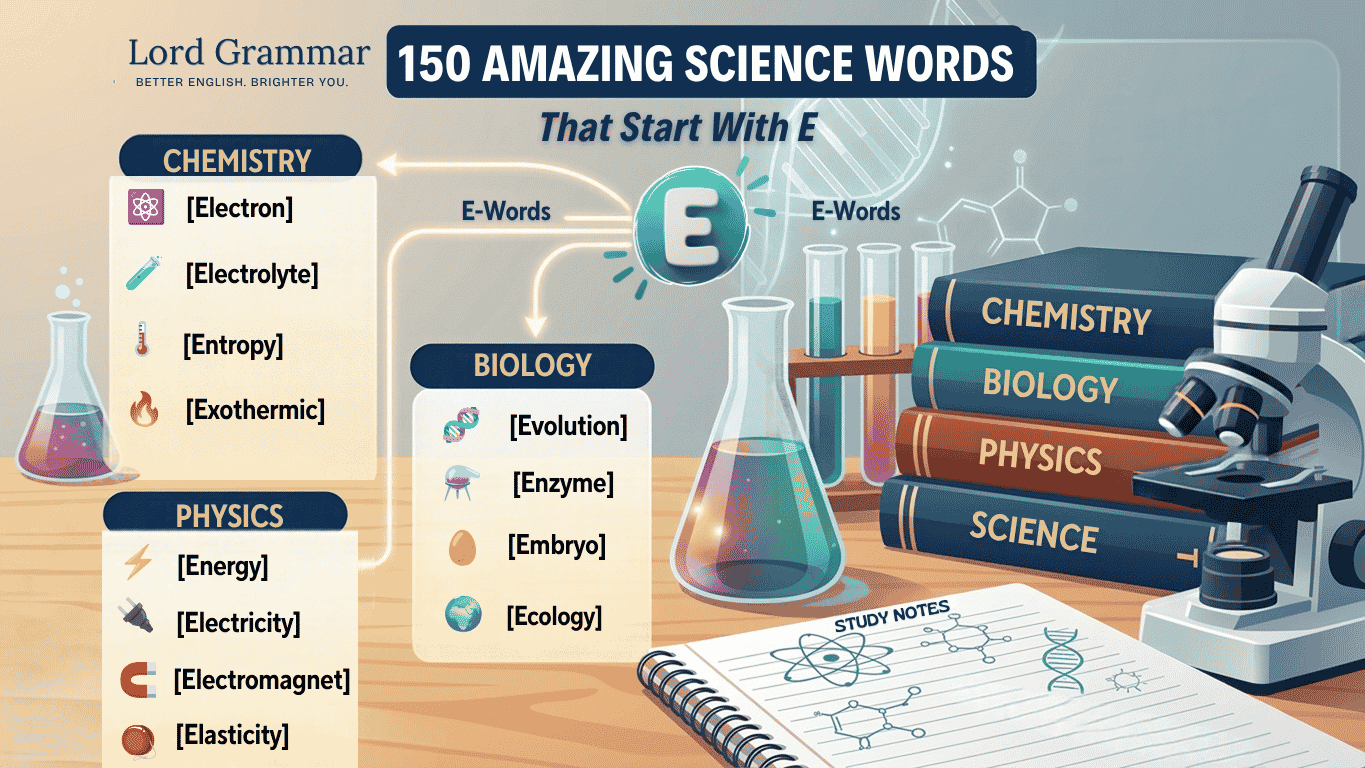
Science uses a rich vocabulary to describe life, matter, energy, Earth, space, and natural processes. Learning science words that start with E can help students understand scientific ideas and build a stronger academic vocabulary.
In this guide, you will discover 150 science words that start with E, organized into 10 major science fields. Each section contains exactly 15 unique terms, with the origin, meaning, and an example sentence.
These science words that start with E include familiar terms such as energy and ecosystem, along with specialized vocabulary used in biology, chemistry, physics, astronomy, geology, medicine, and environmental science.
Biology Words That Start With E
Biology studies living organisms, their structures, functions, development, and interactions. These science words that start with E cover important biological concepts.
| Word | Origin | Meaning | Example Sentence |
|---|---|---|---|
| Ecosystem | Greek | Community of organisms interacting with their environment | A forest is a complex ecosystem. |
| Ecology | Greek | Study of organisms and their relationships with the environment | Ecology helps scientists understand food webs. |
| Ecologist | Greek | Scientist who studies relationships between organisms and their environments | The ecologist studied the wetland habitat. |
| Embryo | Greek | Early developmental stage of a multicellular organism | The embryo continued developing inside the egg. |
| Embryology | Greek | Study of embryo development | Embryology explains how organs develop before birth. |
| Endoskeleton | Greek | Internal skeleton supporting an animal’s body | Humans have an endoskeleton made largely of bone. |
| Endocytosis | Greek | Process by which a cell takes material into itself | The cell uses endocytosis to absorb large particles. |
| Endoplasmic | Greek | Relating to the endoplasmic reticulum inside cells | The endoplasmic reticulum helps process cellular materials. |
| Endosymbiosis | Greek | Relationship in which one organism lives inside another | Endosymbiosis is an important idea in the evolution of organelles. |
| Enzyme | Greek | Protein or RNA molecule that speeds up a biological reaction | Amylase is an enzyme involved in digestion. |
| Epigenetics | Greek | Study of changes in gene activity without changing DNA sequence | Epigenetics examines how environmental factors can influence gene activity. |
| Epidermis | Greek | Outer layer of skin or plant tissue | The epidermis protects the body from the environment. |
| Evolution | Latin | Change in inherited characteristics of populations over generations | Evolution can produce adaptations over many generations. |
| Exoskeleton | Greek | External supporting structure of some animals | An insect’s exoskeleton protects its body. |
| Exocytosis | Greek | Process by which a cell releases materials outside itself | Cells use exocytosis to release certain molecules. |
Chemistry Words That Start With E
Chemistry examines substances, atoms, molecules, reactions, and their properties. These science words that start with E introduce useful chemical concepts.
| Word | Origin | Meaning | Example Sentence |
|---|---|---|---|
| Electron | Greek | Negatively charged subatomic particle | An electron carries a negative electric charge. |
| Electronegativity | Greek | Ability of an atom to attract bonding electrons | Fluorine has very high electronegativity. |
| Electrolyte | Greek | Substance that produces ions in solution and conducts electricity | Sodium chloride acts as an electrolyte in water. |
| Electrolysis | Greek | Chemical decomposition caused by an electric current | Electrolysis can split water into hydrogen and oxygen. |
| Electrode | Greek | Conducting material through which current enters or leaves a system | The electrode was placed into the solution. |
| Emulsion | Latin | Mixture of two liquids that normally do not mix | Milk is a natural emulsion. |
| Enthalpy | Greek | Thermodynamic quantity related to a system’s heat content | The reaction had a negative change in enthalpy. |
| Entropy | Greek | Measure associated with energy dispersal or disorder | Entropy generally increases in an isolated system. |
| Ester | German | Organic compound formed from an acid and alcohol | The compound is an ester with a fruity odor. |
| Ether | Greek | Organic compound containing an oxygen atom between two carbon groups | The chemist used ether as a solvent. |
| Equilibrium | Latin | State in which opposing processes occur at balanced rates | The reaction reached chemical equilibrium. |
| Equivalence | Latin | Condition where chemically equivalent amounts have reacted | The titration reached the equivalence point. |
| Evaporation | Latin | Change of a liquid into a gas at its surface | Evaporation cooled the remaining liquid. |
| Exothermic | Greek | Releasing heat to the surroundings | Burning fuel is an exothermic process. |
| Endothermic | Greek | Absorbing heat from the surroundings | Some chemical reactions are endothermic. |
Physics Words That Start With E
Physics explores matter, energy, motion, forces, electricity, and waves. These science words that start with E describe major physical principles.
| Word | Origin | Meaning | Example Sentence |
|---|---|---|---|
| Energy | Greek | Capacity to cause change or perform work | Solar panels convert sunlight into electrical energy. |
| Electricity | Greek | Set of phenomena associated with electric charge | Electricity powers many modern devices. |
| Electric field | Greek | Region where an electric charge experiences force | The charged particle moved through an electric field. |
| Electromagnet | Greek | Magnet produced by electric current | The electromagnet lifted the metal object. |
| Electromagnetism | Greek | Branch of physics concerning electric and magnetic phenomena | Electromagnetism explains how electric currents create magnetic fields. |
| Electromotive force | Greek/Latin | Energy supplied per unit charge by a source | The battery provides electromotive force to the circuit. |
| Elasticity | Greek | Ability of a material to return toward its original shape | Rubber has noticeable elasticity. |
| Elastic potential | Greek | Stored energy associated with deformation | The stretched spring contained elastic potential energy. |
| Emission | Latin | Release of energy, particles, or radiation | The excited atom produced light emission. |
| Emissivity | Latin | Measure of how efficiently a surface emits thermal radiation | Dark surfaces often have high emissivity. |
| Equilibrium | Latin | Condition where forces or processes are balanced | The object remained in mechanical equilibrium. |
| Excitation | Latin | Increase of a system’s energy to a higher state | The atom underwent excitation after absorbing energy. |
| Expansion | Latin | Increase in size or volume | Heating caused thermal expansion of the metal. |
| Elastic collision | Greek/Latin | Collision in which kinetic energy is conserved | The idealized model assumes an elastic collision. |
| Entanglement | German/English | Quantum relationship in which particle states are strongly correlated | Quantum entanglement has been observed experimentally. |
Astronomy Words That Start With E
Astronomy studies stars, planets, galaxies, cosmic structures, and events. These science words that start with E describe astronomical objects and processes.
| Word | Origin | Meaning | Example Sentence |
|---|---|---|---|
| Earth | Old English | Third planet from the Sun | Earth has liquid surface water and a diverse biosphere. |
| Eclipse | Greek | Event in which one celestial body blocks another from view | A solar eclipse occurs when the Moon passes between Earth and the Sun. |
| Ecliptic | Greek | Apparent yearly path of the Sun across the sky | The planets generally orbit near the ecliptic plane. |
| Exoplanet | Greek/English | Planet orbiting a star outside our Solar System | Astronomers discovered an exoplanet around a distant star. |
| Exosphere | Greek | Outermost layer of Earth’s atmosphere | The exosphere gradually merges with outer space. |
| Equinox | Latin | Time when day and night are approximately equal in length | The March equinox marks a seasonal transition. |
| Elliptical galaxy | Greek | Galaxy with an oval or spheroidal shape | The cluster contains several elliptical galaxies. |
| Escape velocity | English/Latin | Minimum speed needed to escape a body’s gravitational field | A rocket needs enough escape velocity to leave Earth permanently. |
| Event horizon | English | Boundary around a black hole beyond which escape is impossible | Light cannot return after crossing the event horizon. |
| Emission line | Latin | Bright spectral line produced by emitted radiation | The emission line revealed information about the gas. |
| Emission spectrum | Latin | Pattern of wavelengths emitted by a source | Each element can produce a distinctive emission spectrum. |
| Ephemeris | Greek | Table or data giving predicted positions of celestial objects | The astronomer checked the ephemeris before observing the planet. |
| Eris | Greek | Dwarf planet in the distant Solar System | Eris orbits far beyond Neptune. |
| Europa | Greek | Moon of Jupiter known for its icy surface | Europa may contain an ocean beneath its ice. |
| Extragalactic | Greek/Latin | Located outside the Milky Way Galaxy | The telescope captured extragalactic objects. |
Earth Science Words That Start With E
Earth science examines Earth’s atmosphere, land, oceans, climate, and geological processes. These science words that start with E cover important Earth-related concepts.
| Word | Origin | Meaning | Example Sentence |
|---|---|---|---|
| Earthquake | Old English | Sudden movement of Earth’s crust caused by released energy | The earthquake damaged several buildings. |
| Erosion | Latin | Removal and transport of soil or rock by natural forces | Running water can cause erosion. |
| Ecosphere | Greek | Broad system including living organisms and their environments | Scientists use the term ecosphere when discussing global life systems. |
| Estuary | Latin | Coastal area where freshwater mixes with seawater | Many fish species use the estuary as a nursery. |
| Evaporation | Latin | Process by which liquid water becomes vapor | Heat increases the rate of evaporation. |
| Evapotranspiration | Latin | Combined water loss through evaporation and plant transpiration | Evapotranspiration affects the regional water cycle. |
| Epicenter | Greek | Point on Earth’s surface directly above an earthquake’s focus | The epicenter was located near the coast. |
| Erosion surface | Latin | Land surface shaped by prolonged erosion | The geologist identified an ancient erosion surface. |
| Escarpment | Dutch/French | Long, steep slope separating relatively level areas | The escarpment stretches across the valley. |
| Eolian | Greek | Relating to processes caused by wind | Eolian deposits formed across the desert. |
| Evaporite | Latin | Sedimentary mineral deposit formed by evaporation | Halite is a common evaporite mineral. |
| Earthflow | Old English | Mass movement of soil or fine material downslope | Heavy rainfall triggered an earthflow. |
| El Niño | Spanish | Periodic warming of surface waters in the central and eastern tropical Pacific | El Niño can influence weather patterns around the world. |
| Equilibrium line | Latin/English | Boundary on a glacier where annual accumulation equals melting | The glacier’s equilibrium line moved upward. |
| Endorheic | Greek | Describing a drainage basin with no outlet to the ocean | The lake lies within an endorheic basin. |
Environmental Science Words That Start With E
Environmental science studies ecosystems, resources, pollution, climate, and human impacts on nature. These science words that start with E are useful environmental terms.
| Word | Origin | Meaning | Example Sentence |
|---|---|---|---|
| Ecology | Greek | Study of interactions between organisms and their environment | Ecology helps explain how species share resources. |
| Ecological footprint | Greek/Latin | Measure of human demand on Earth’s productive resources | Reducing consumption can lower an ecological footprint. |
| Ecosystem | Greek | Community of organisms and their physical environment | A pond can function as an ecosystem. |
| Ecotoxicology | Greek | Study of harmful effects of pollutants on ecosystems | Ecotoxicology examines the effects of chemicals on aquatic life. |
| Endangered | Latin | At serious risk of extinction | The species is listed as endangered. |
| Endemic | Greek | Native to and restricted to a particular geographic area | The island has several endemic species. |
| Environmentalism | French/Latin | Movement focused on protecting the natural environment | Environmentalism has influenced conservation policies. |
| Eutrophication | Greek | Excessive nutrient enrichment of a body of water | Fertilizer runoff can cause eutrophication. |
| Emission | Latin | Release of gases, particles, or other substances | Vehicle emission contributes to air pollution. |
| Effluent | Latin | Liquid waste discharged from a facility or process | The factory treated its effluent before release. |
| Ecosystem service | Greek/Latin | Benefit people receive from functioning ecosystems | Pollination is an important ecosystem service. |
| Ecological niche | Greek | Role and position of a species within its ecosystem | Each species occupies a particular ecological niche. |
| Environmental indicator | Latin | Measurement or organism used to show environmental conditions | Water quality can serve as an environmental indicator. |
| Environmental impact | Latin | Effect of an activity on the environment | The project required an environmental impact assessment. |
| Ecological restoration | Greek/Latin | Process of helping damaged ecosystems recover | Ecological restoration improved the degraded wetland. |
Medical Science Words That Start With E
Medical science studies the human body, diseases, diagnosis, and treatment. These science words that start with E are useful terms in medicine and health sciences.
| Word | Origin | Meaning | Example Sentence |
|---|---|---|---|
| Epidermis | Greek | Outer layer of the skin | The epidermis provides a protective barrier. |
| Epidemic | Greek | Disease occurrence above the expected level in a population | The region experienced an epidemic of the infection. |
| Epidemiology | Greek | Study of disease patterns and causes in populations | Epidemiology helps identify disease risk factors. |
| Edema | Greek | Abnormal accumulation of fluid in tissues | The injury caused swelling and edema. |
| Electrocardiogram | Greek | Recording of the heart’s electrical activity | The doctor ordered an electrocardiogram. |
| Electrolyte | Greek | Substance that forms electrically charged particles in body fluids | Potassium is an important electrolyte. |
| Embolism | Greek | Blockage of a blood vessel by material carried through the bloodstream | The doctors investigated the possibility of an embolism. |
| Endocrine | Greek | Relating to glands that release hormones into the bloodstream | The endocrine system regulates many body processes. |
| Endocrinology | Greek | Medical study of hormones and endocrine glands | Endocrinology focuses on hormone-related conditions. |
| Endometrium | Greek | Inner lining of the uterus | The endometrium changes during the menstrual cycle. |
| Encephalitis | Greek | Inflammation of the brain | Viral infections can sometimes cause encephalitis. |
| Endoscopy | Greek | Examination of internal body structures using an endoscope | The physician performed an endoscopy. |
| Enzyme | Greek | Biological catalyst that speeds up chemical reactions | Digestive enzymes help break down food. |
| Epilepsy | Greek | Neurological disorder involving recurrent seizures | The patient was evaluated for epilepsy. |
| Erythrocyte | Greek | Red blood cell | An erythrocyte carries oxygen using hemoglobin. |
Geology Words That Start With E
Geology studies rocks, minerals, Earth’s layers, and geological processes. These science words that start with E describe geological materials and structures.
| Word | Origin | Meaning | Example Sentence |
|---|---|---|---|
| Earthflow | Old English | Downslope movement of water-rich soil or fine sediment | The saturated hillside developed an earthflow. |
| Eclogite | Greek | High-pressure metamorphic rock containing characteristic minerals | The geologist identified the sample as eclogite. |
| Edifice | Latin | Large geological structure, especially a volcanic construction | The volcanic edifice rises above the surrounding plain. |
| Epidote | Greek | Green mineral commonly found in metamorphic rocks | Epidote occurred in the metamorphic sample. |
| Evaporite | Latin | Mineral deposit formed by evaporation of water | The basin contains thick evaporite layers. |
| Erosion | Latin | Wearing away and transport of geological material | River erosion shaped the canyon. |
| Epeirogeny | Greek | Large-scale vertical movement of continental crust | Epeirogeny can raise broad regions without intense folding. |
| Epicenter | Greek | Surface point directly above an earthquake’s focus | The epicenter was mapped using seismic data. |
| Epigenesis | Greek | Geological process in which minerals form or change after rock formation | Epigenesis altered the original mineral assemblage. |
| Extrusive | Latin | Formed from lava that cools at Earth’s surface | Basalt is a common extrusive igneous rock. |
| Exfoliation | Latin | Peeling or removal of outer rock layers | Exfoliation produced rounded granite surfaces. |
| Extinction | Latin | Disappearance of a mineral or fossil species from the geological record | The fossil record shows the extinction of several species. |
| Erosion rate | Latin | Rate at which material is removed from a surface | Researchers measured the erosion rate of the riverbank. |
| Earth material | Old English/Latin | Naturally occurring material forming part of Earth | Soil and rock are common Earth materials. |
| Eolianite | Greek | Rock formed mainly from wind-deposited sand | The coastal cliff contains eolianite. |
Botany Words That Start With E
Botany focuses on plants, their structures, growth, reproduction, and classification. These science words that start with E describe plant structures and processes.
| Word | Origin | Meaning | Example Sentence |
|---|---|---|---|
| Epidermis | Greek | Outer protective tissue of a plant | The leaf epidermis reduces water loss. |
| Endosperm | Greek | Nutritive tissue supporting the developing plant embryo in many seeds | The endosperm provides stored food for the embryo. |
| Embryo | Greek | Young plant developing within a seed | The seed contains a developing embryo. |
| Epiphyte | Greek | Plant that grows on another plant without being a parasite | Many orchids are epiphytes. |
| Evergreen | English | Plant that retains functional leaves throughout the year | Pine trees are commonly evergreen. |
| Elaiosome | Greek | Fleshy seed structure attractive to ants | Ants carried the seed because of its elaiosome. |
| Endocarp | Greek | Innermost layer of a fruit wall | The hard endocarp surrounds the seed in a peach. |
| Exocarp | Greek | Outer layer of a fruit wall | The exocarp forms the outer skin of the fruit. |
| Endodermis | Greek | Inner layer of cells in a plant root | The endodermis regulates movement into the vascular tissue. |
| Epidermal | Greek | Relating to the plant epidermis | Epidermal cells form the leaf’s outer layer. |
| Elater | Greek | Specialized structure that helps disperse spores in some plants | The elater assists spore dispersal in certain liverworts. |
| Emergence | Latin | Process of a plant shoot appearing above the soil | Seedling emergence occurred after several days. |
| Embryogenesis | Greek | Formation and development of a plant embryo | Embryogenesis begins after fertilization. |
| Enation | Latin | Outgrowth from a plant surface | The leaf developed a small enation. |
| Epicalyx | Greek | Additional whorl of structures outside the calyx in some flowers | The flower has a prominent epicalyx. |
Zoology Words That Start With E
Zoology studies animals, including their anatomy, behavior, evolution, and classification. These science words that start with E introduce useful animal science vocabulary.
| Word | Origin | Meaning | Example Sentence |
|---|---|---|---|
| Echinoderm | Greek | Marine animal with radial symmetry as an adult, such as a starfish | A starfish is an echinoderm. |
| Ectotherm | Greek | Animal whose body temperature is strongly influenced by external conditions | Many reptiles are ectotherms. |
| Ectoparasite | Greek | Parasite that lives on the outside of a host | A tick is an ectoparasite. |
| Ectoderm | Greek | Outer embryonic germ layer | The ectoderm contributes to the nervous system. |
| Endoparasite | Greek | Parasite living inside its host | Some worms are endoparasites. |
| Endotherm | Greek | Animal that generates substantial internal heat to regulate body temperature | Birds are endotherms. |
| Endoskeleton | Greek | Internal skeletal structure | Mammals have an endoskeleton. |
| Endosymbiont | Greek | Organism living within another organism in a symbiotic relationship | Certain microorganisms act as endosymbionts. |
| Echolocation | Greek | Use of reflected sound to locate objects | Bats use echolocation to navigate. |
| Ecdysis | Greek | Shedding of an outer body covering | Snakes undergo ecdysis as they grow. |
| Elytron | Greek | Hardened forewing of a beetle | The beetle’s elytron protects its flying wings. |
| Eusocial | Greek | Describing animal societies with cooperative care and reproductive division | Ant colonies are examples of eusocial systems. |
| Estivation | Latin | Dormant state during hot or dry conditions | Some snails enter estivation during dry weather. |
| Exoskeleton | Greek | External supportive body covering | The crab’s exoskeleton protects its body. |
| Egg case | Old English | Protective structure containing animal eggs | The shark’s egg case washed onto the beach. |
Conclusion
This collection of 150 science words that start with E covers 10 major science fields, including biology, chemistry, physics, astronomy, Earth science, environmental science, medical science, geology, botany, and zoology.
The list includes familiar terms such as energy, electron, ecosystem, evolution, erosion, earthquake, ecology, enzyme, exoplanet, and echinoderm, along with more specialized scientific vocabulary.
Learning science words that start with E can make scientific reading easier and help students recognize important terminology across different subjects. Organizing the vocabulary by scientific field also makes it easier to understand how each term is used.
For additional science learning resources, readers can explore OpenStax, which provides free educational textbooks covering subjects such as biology, chemistry, physics, and other sciences.
Frequently Asked Questions
What are some science words that start with E?
Some common science words that start with E include energy, electron, enzyme, ecosystem, ecology, evolution, erosion, earthquake, exoplanet, and echinoderm.
What is a biology word that starts with E?
Ecosystem is an important biology word that starts with E. It describes organisms interacting with one another and with their physical environment.
What is a chemistry word that starts with E?
Electron is an important chemistry word beginning with E. It is a negatively charged subatomic particle found around atomic nuclei.
What is a physics word that starts with E?
Energy is one of the most important physics terms beginning with E. It describes the capacity of a system to cause change or perform work.
What is an astronomy word that starts with E?
Exoplanet is a common astronomy word beginning with E. It refers to a planet orbiting a star outside our Solar System.
What is a geology word that starts with E?
Eclogite is a geology term beginning with E. It is a high-pressure metamorphic rock associated with particular deep geological environments.