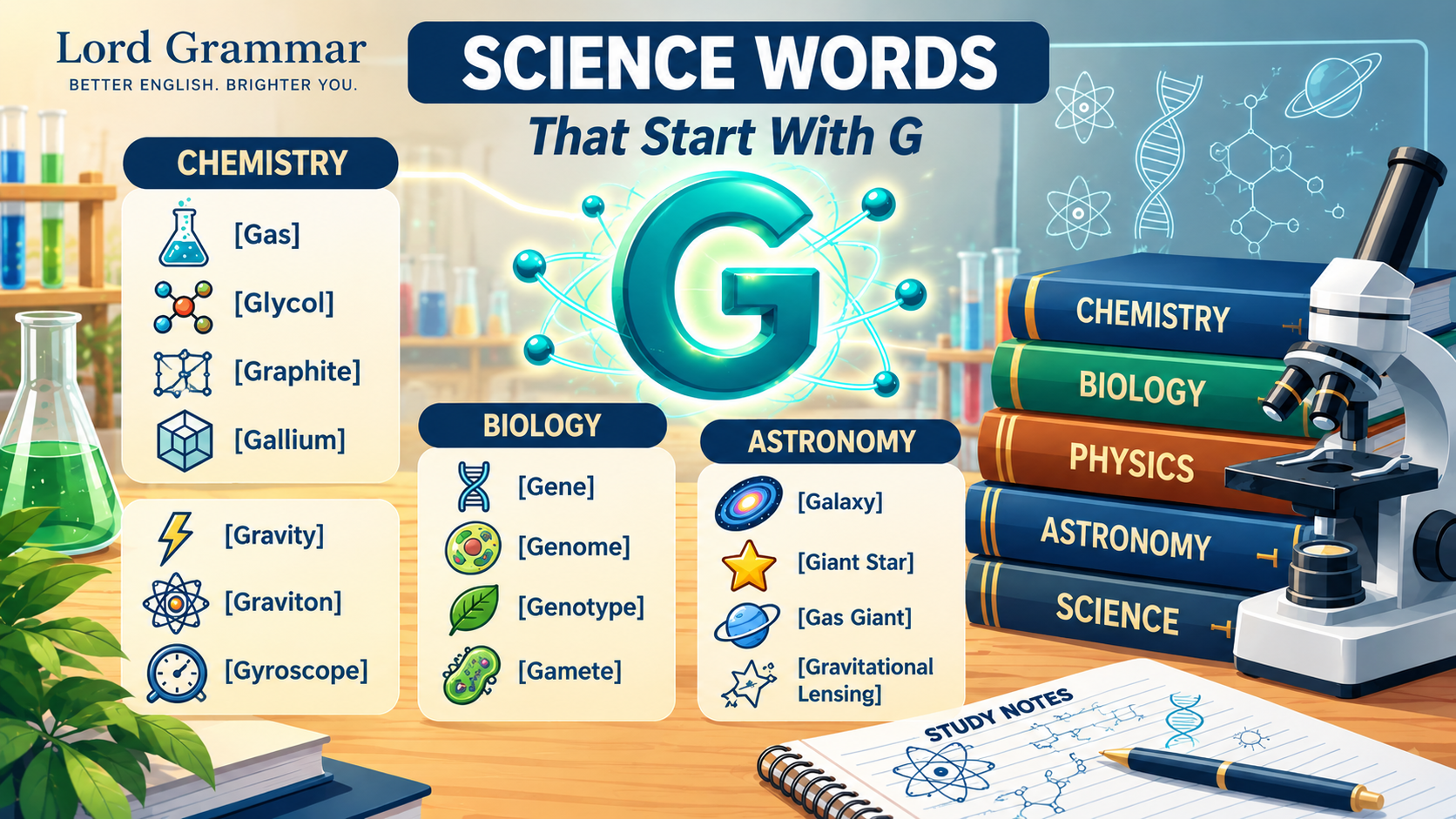
Science helps us understand the world around us. It explains how plants grow, why objects fall, and how stars shine. Many useful science words that start with G help us learn about life, matter, energy, and space.
In this guide, you will find 150 science words that start with G. Each word has its origin, a simple meaning, and an example sentence. These words can help students, teachers, and science lovers build a stronger vocabulary.
Chemistry Words That Start With G
Chemistry is the study of matter and how substances change. These science words that start with G can help you learn about chemicals, materials, and chemical reactions.
| Word | Origin | Meaning | Example Sentence |
|---|---|---|---|
| Gas | Greek | A state of matter with no fixed shape or volume. | Oxygen is a gas at room temperature. |
| Gallium | Latin | A soft, silvery metal. | Gallium is used in some electronic devices. |
| Graphite | Greek | A soft form of carbon. | Graphite is used in pencil cores. |
| Glucose | Greek | A simple sugar that gives cells energy. | Our cells use glucose for energy. |
| Glycerol | Greek | A clear liquid found in fats and oils. | Glycerol is used in some skin products. |
| Glycol | Greek | A type of alcohol used in many chemical products. | Ethylene glycol is used in antifreeze. |
| Glycerin | Greek | Another name for glycerol. | Glycerin helps keep some creams moist. |
| Gel | French | A soft material that holds liquid. | The scientist made a gel for the test. |
| Gelation | French | The process of forming a gel. | Cooling caused gelation in the mixture. |
| Gasification | Greek | The process of turning material into gas. | Gasification can turn plant waste into fuel. |
| Galvanization | Italian | Coating iron or steel with zinc to prevent rust. | Galvanization helps protect steel from rust. |
| Galvanic cell | Italian | A device that makes electricity through a chemical reaction. | A galvanic cell can power a small circuit. |
| Galvanometer | Italian and Greek | A tool that detects small electric currents. | The galvanometer showed an electric current. |
| Gravimetry | Latin | A way to study a substance by measuring its mass. | Gravimetry helped measure the solid sample. |
| Glass | Old English | A hard material often made from sand-based substances. | The lab uses glass tubes for experiments. |
Biology Words That Start With G
Biology is the study of living things. These science words that start with G explain genes, cells, growth, and other parts of life.
| Word | Origin | Meaning | Example Sentence |
|---|---|---|---|
| Gene | Greek | A part of DNA that carries instructions. | A gene can affect eye color. |
| Genome | German and Greek roots | All the genetic material in an organism. | Scientists studied the human genome. |
| Genotype | Greek | The genetic makeup of an organism. | The genotype may affect a plant’s traits. |
| Genetics | Greek | The study of genes and inherited traits. | Genetics helps explain family traits. |
| Genomics | Greek | The study of an organism’s full set of genes. | Genomics helps scientists study diseases. |
| Gamete | Greek | A reproductive cell, such as an egg or sperm. | An egg is a female gamete. |
| Gametogenesis | Greek | The process of making reproductive cells. | Gametogenesis produces eggs or sperm. |
| Gametophyte | Greek | A stage in the life cycle of plants. | The moss gametophyte makes reproductive cells. |
| Gastrula | Greek | An early stage of embryo growth. | The embryo developed into a gastrula. |
| Gastrulation | Greek | An early process that forms layers in an embryo. | Gastrulation helps shape the growing embryo. |
| Gland | Latin | A body part that makes and releases substances. | The salivary gland makes saliva. |
| Glia | Greek | Cells that support and protect nerve cells. | Glia help keep the brain healthy. |
| Glycogen | Greek | A stored form of sugar in animals and fungi. | Muscles store glycogen for later use. |
| Germination | Latin | The start of growth from a seed or spore. | Warm soil helped seed germination. |
| Germ cell | Latin | A cell that can form an egg or sperm. | A germ cell carries genetic information. |
Physics Words That Start With G
Physics explains forces, motion, energy, and matter. These science words that start with G introduce useful ideas in physics.
| Word | Origin | Meaning | Example Sentence |
|---|---|---|---|
| Gravity | Latin | The force of attraction between objects with mass. | Gravity keeps us on the ground. |
| Graviton | Latin | A proposed particle linked to gravity. | Scientists study whether the graviton exists. |
| Gyroscope | Greek | A device that helps measure direction or balance. | A gyroscope helps a drone stay stable. |
| Gyroscopic motion | Greek | The motion of a spinning object. | Gyroscopic motion helps a spinning wheel stay steady. |
| Gamma ray | Greek | A very high-energy form of light. | A space telescope detected a gamma ray. |
| Gamma radiation | Greek | Energy that travels as gamma rays. | Gamma radiation needs special shielding. |
| Gauge | French | A tool used to measure something. | The gauge showed the air pressure. |
| Geophone | Greek | A tool that detects ground movement. | The geophone recorded small ground vibrations. |
| Gigahertz | Greek and German | One billion cycles per second. | The computer chip runs at several gigahertz. |
| Gradient | Latin | The rate at which something changes. | Heat moves along a temperature gradient. |
| Ground state | English | The lowest energy state of an atom or system. | The electron returned to its ground state. |
| Gravitational field | Latin | The area where gravity can affect objects. | Earth has a gravitational field around it. |
| Gravitational force | Latin | The force of attraction between objects with mass. | Gravitational force keeps the Moon near Earth. |
| Gravitational potential | Latin | Energy linked to an object’s place in a gravitational field. | The raised ball gained gravitational potential energy. |
| Gravitational acceleration | Latin | The change in speed caused by gravity. | Gravitational acceleration makes a dropped ball fall. |
Astronomy Words That Start With G
Astronomy is the study of space and the objects in it. These science words that start with G help explain stars, galaxies, and planets.
| Word | Origin | Meaning | Example Sentence |
|---|---|---|---|
| Galaxy | Greek | A large group of stars, gas, dust, and dark matter. | The Milky Way is our galaxy. |
| Galactic | Greek | Related to a galaxy. | Galactic dust can block light from stars. |
| Galaxy cluster | Greek | A group of galaxies held together by gravity. | Scientists found a distant galaxy cluster. |
| Giant star | Latin | A star much larger than many stars of similar temperature. | A giant star can grow as it ages. |
| Gas giant | Greek and Latin | A large planet made mainly of gases and fluids. | Jupiter is a gas giant. |
| Globular cluster | Latin | A round group of many stars. | The globular cluster contains old stars. |
| Gravitational lensing | Latin | The bending of light by gravity. | Gravitational lensing can make distant galaxies look brighter. |
| Gravitational wave | Latin | A ripple in space and time caused by moving masses. | Scientists detected a gravitational wave. |
| Goldilocks zone | English | The area where a planet may have liquid water on its surface. | Earth lies in the Sun’s Goldilocks zone. |
| Gamma-ray burst | Greek | A short, powerful flash of gamma rays from space. | A satellite detected a gamma-ray burst. |
| G-type star | Scientific classification | A star in a certain group based on its light and heat. | The Sun is a G-type star. |
| Galactic halo | Greek | A large region around a galaxy’s main disk. | The Milky Way has a galactic halo. |
| Galactic bulge | Greek and Latin | A dense group of stars near a galaxy’s center. | Many old stars are found in the galactic bulge. |
| Geostationary orbit | Greek and Latin | An orbit where a satellite appears fixed over one place on Earth. | A TV satellite may use a geostationary orbit. |
| Giant molecular cloud | Latin | A huge cloud of cold gas and dust in space. | New stars can form inside a giant molecular cloud. |
Earth Science Words That Start With G
Earth science helps us understand rocks, land, water, and the forces that shape our planet.
| Word | Origin | Meaning | Example Sentence |
|---|---|---|---|
| Geology | Greek | The study of Earth’s rocks, structure, and history. | Geology helps explain how mountains form. |
| Geologist | Greek | A scientist who studies rocks and Earth. | The geologist examined the rocks. |
| Geochemistry | Greek | The study of chemicals found in Earth and its materials. | Geochemistry helped identify minerals in the soil. |
| Geophysics | Greek | The study of Earth using ideas from physics. | Geophysics helps scientists study what lies underground. |
| Geosphere | Greek | The solid parts of Earth. | Rocks and soil belong to the geosphere. |
| Geomorphology | Greek | The study of landforms and how they change. | Geomorphology helps explain river valleys. |
| Glacier | French | A large mass of ice that moves slowly over land. | The glacier carved a deep valley. |
| Glaciology | Latin | The study of glaciers and ice. | Glaciology helps track changes in polar ice. |
| Glacial | Latin | Related to glaciers or ice ages. | Glacial ice shaped the valley. |
| Geyser | Icelandic | A hot spring that shoots out water and steam. | The geyser sent hot water into the air. |
| Gabbro | Italian | A dark rock formed when melted rock cools underground. | Gabbro forms deep below Earth’s surface. |
| Gneiss | German | A rock with bands of different minerals. | The cliff contained layers of gneiss. |
| Granite | Latin | A hard rock made of several minerals. | Granite is often used in buildings. |
| Gravel | French | Small pieces of broken rock. | Gravel covered the garden path. |
| Groundwater | English | Water stored beneath Earth’s surface. | Wells can provide groundwater for homes. |
Environmental Science Words That Start With G
Environmental science studies nature, pollution, and the links between living things and their surroundings.
| Word | Origin | Meaning | Example Sentence |
|---|---|---|---|
| Greenhouse gas | English and Greek roots | A gas that traps heat in the atmosphere. | Carbon dioxide is a greenhouse gas. |
| Greenhouse effect | English and Greek roots | The warming caused by gases that absorb heat in the atmosphere. | The greenhouse effect helps keep Earth warm. |
| Green energy | English | Energy made with low pollution or environmental harm. | Wind power is a form of green energy. |
| Green technology | English | Technology designed to reduce harm to nature. | Green technology can save energy. |
| Green chemistry | English and Greek | Designing chemicals and processes that create less waste. | Green chemistry helps reduce harmful waste. |
| Ground pollution | English | Harmful substances in soil or land. | Poor waste disposal can cause ground pollution. |
| Groundwater recharge | English | The process of water filling underground stores. | Rain helps groundwater recharge. |
| Grazing | Old English | Feeding on grass and other plants. | Grazing animals feed in open fields. |
| Grassland | Old English | Land where grasses are the main plants. | Many animals live in grassland habitats. |
| Genetic diversity | Greek and Latin | Differences in genes among living things. | Genetic diversity can help a species survive change. |
| Gene pool | Greek and English | All the genes in a group of organisms that can reproduce. | Migration can change a population’s gene pool. |
| Generalist species | Latin | A species that can live in many places or eat many foods. | A raccoon is a generalist species. |
| Green algae | English and Latin | Simple living things that use sunlight to make food. | Green algae grow in ponds. |
| Gyre | Greek | A large circle of ocean currents. | Plastic waste can collect in an ocean gyre. |
| Global warming | English | The long-term rise in Earth’s average temperature. | Global warming affects the climate. |
Medical Science Words That Start With G
Medical science studies the human body, health, and the causes of disease. These terms can help you understand basic medical topics.
| Word | Origin | Meaning | Example Sentence |
|---|---|---|---|
| Gastric | Greek | Related to the stomach. | Gastric juices help break down food. |
| Gastroenterology | Greek | The study and treatment of digestive system problems. | Gastroenterology covers the stomach and intestines. |
| Gingiva | Latin | The soft gum tissue around the teeth. | Healthy gingiva helps support the teeth. |
| Gingivitis | Latin | Swelling and redness of the gums. | Poor oral care can lead to gingivitis. |
| Glomerulus | Latin | A small group of blood vessels in the kidney. | The glomerulus filters blood. |
| Glomerular filtration | Latin | The movement of fluid from blood into kidney filters. | Glomerular filtration helps the body make urine. |
| Glucagon | Greek | A hormone that raises blood sugar. | Glucagon helps raise blood glucose when it falls. |
| Glycemia | Greek | The level of glucose in the blood. | The test measured blood glycemia. |
| Glycolysis | Greek | The process cells use to break down glucose for energy. | Glycolysis begins the breakdown of glucose. |
| Glycoprotein | Greek | A protein with sugar groups attached. | Some cell receptors are glycoproteins. |
| Glycolipid | Greek | A fat-like molecule with a sugar group attached. | Glycolipids are found in cell membranes. |
| Glycogenesis | Greek | The process of making glycogen from glucose. | Glycogenesis stores extra glucose. |
| Glycogenolysis | Greek | The breakdown of stored glycogen. | Glycogenolysis helps release stored glucose. |
| Gluconeogenesis | Greek | The process of making glucose from other substances. | Gluconeogenesis helps maintain blood glucose during fasting. |
| Gene therapy | Greek | Treatment that uses genetic material to help fight disease. | Gene therapy can treat some inherited conditions. |
Scientific Methods and Measurement Words That Start With G
Scientists use measurements, graphs, and tests to study questions. These terms appear in many fields of science.
| Word | Origin | Meaning | Example Sentence |
|---|---|---|---|
| Graph | Greek | A picture that shows data or a relationship. | The graph showed a rise in temperature. |
| Graphing | Greek | Showing information on a graph. | Graphing the results made the pattern clear. |
| Graphical analysis | Greek | Studying information by looking at graphs. | Graphical analysis helped compare the results. |
| Grid | French | A set of crossing lines used to mark places. | The scientist marked each sample on a grid. |
| Grid system | French and Latin | A network used to arrange or locate points. | The team used a grid system to map the area. |
| Gravimeter | Latin | A tool that measures changes in gravity. | The gravimeter recorded a small change in gravity. |
| Gravimetric analysis | Latin | A method of finding an amount by measuring mass. | Gravimetric analysis measured the solid sample. |
| Grounding | English | Connecting an electrical system to the ground for safety. | Grounding helps reduce electrical hazards. |
| Gain | Old French | An increase in a signal or amount. | The amplifier increased the signal gain. |
| Gaussian distribution | Named after Carl Friedrich Gauss | A bell-shaped pattern found in some data. | The measurements followed a Gaussian distribution. |
| Gaussian function | Named after Carl Friedrich Gauss | A mathematical function with a bell-shaped curve. | The scientist used a Gaussian function to fit the data. |
| Gradient descent | Latin and English | A method for finding a lower value of a function. | Gradient descent helped improve the model. |
| Genetic algorithm | Greek and Arabic-derived terminology | A computer method based on ideas from natural selection. | The genetic algorithm searched for a solution. |
| Geodesic | Greek | A shortest path on a curved surface or in curved space. | A geodesic can show the shortest route on a sphere. |
| Gauge pressure | French | Pressure measured compared with the surrounding air pressure. | The gauge pressure rose inside the tank. |
Advanced Science Words That Start With G
These science words that start with G may look difficult at first, but simple meanings can make them easier to learn.
| Word | Origin | Meaning | Example Sentence |
|---|---|---|---|
| Graphene | Greek | A very thin layer of carbon atoms. | Graphene is studied for its strength. |
| Graphene oxide | Greek | A form of graphene with oxygen-containing groups. | Researchers tested graphene oxide in water treatment. |
| Graphite oxide | Greek | A material made by adding oxygen to graphite. | Graphite oxide can be used to make graphene oxide. |
| Geopolymer | Greek | A type of mineral-based material. | A geopolymer can be used in building materials. |
| Geopolymerization | Greek | The process of forming a geopolymer. | Geopolymerization changed the mixture into a solid. |
| Glycoside | Greek | A compound that contains a sugar group linked to another group. | The plant sample contained a glycoside. |
| Glycosylation | Greek | The process of attaching sugar groups to a molecule. | Glycosylation can change how a protein works. |
| Glycosidic bond | Greek | A bond that links a sugar to another group. | A glycosidic bond links sugar units in carbohydrates. |
| Glycosaminoglycan | Greek | A long sugar chain found in body tissues. | Hyaluronic acid is a glycosaminoglycan. |
| Glycoproteomics | Greek | The large-scale study of proteins with sugar groups. | Glycoproteomics helps scientists study protein changes. |
| Gravitational constant | Latin | A number used to calculate gravitational attraction. | The gravitational constant appears in Newton’s law of gravity. |
| Gravitational singularity | Latin | A point or region where a gravity model breaks down. | A black hole model may contain a gravitational singularity. |
| Gauge boson | French and Greek | A particle linked to a basic force in physics. | The photon is a gauge boson. |
| Gravitational potential energy | Latin | Energy linked to an object’s position in a gravitational field. | The raised ball had gravitational potential energy. |
| Gravitational microlensing | Latin | A small change in light caused by gravity bending it. | Gravitational microlensing can help find distant planets. |
More Science Words That Start With G
This final group adds more terms from genetics, astronomy, Earth science, and physics.
| Word | Origin | Meaning | Example Sentence |
|---|---|---|---|
| Gene expression | Greek and Latin | The process of using information in a gene. | Gene expression changes as cells grow. |
| Gene regulation | Greek and Latin | The control of when a gene is used. | Gene regulation helps cells respond to change. |
| Gene editing | Greek and English | Making planned changes to DNA. | Gene editing is studied in medical research. |
| Genetic drift | Greek and Old English | A random change in gene forms within a population. | Genetic drift can affect small populations. |
| Genetic marker | Greek and Latin | A DNA feature used to track a gene or trait. | Researchers used a genetic marker to study inheritance. |
| Genetic code | Greek and Latin | The rules cells use to read genetic information. | The genetic code links DNA instructions to proteins. |
| Genetic engineering | Greek and Latin | Changing genetic material to give a desired result. | Genetic engineering can change crop traits. |
| Germ theory | Latin and Greek | The idea that many diseases are caused by tiny living agents. | Germ theory changed modern medicine. |
| Geothermal gradient | Greek and Latin | The rate at which Earth’s temperature rises with depth. | Scientists measured the geothermal gradient underground. |
| Geostrophic wind | Greek | Wind shaped by pressure differences and Earth’s rotation. | Geostrophic wind affects large weather systems. |
| Geodesic dome | Greek | A dome made from connected straight parts. | The science center has a geodesic dome. |
| Geocentric model | Greek | An old model that placed Earth at the center of the cosmos. | The geocentric model was used in early astronomy. |
| Guanine | Greek | A chemical base found in DNA and RNA. | Guanine pairs with cytosine in DNA. |
| Geothermal power | Greek | Energy made using heat from inside Earth. | Geothermal power can produce electricity. |
| Greenhouse warming | English | Warming caused by heat-trapping gases in an atmosphere. | Greenhouse warming can raise Earth’s average temperature. |
Conclusion
These 150 science words that start with G cover chemistry, biology, physics, astronomy, Earth science, and more. Words such as gravity, galaxy, glucose, gene, and geology are useful starting points for students.
Learn a few words each day and practice using them in sentences. Over time, these science words that start with G can help you understand lessons, read science books, and explain scientific ideas more clearly.
Frequently Asked Questions
What are some common science words that start with G?
Common examples include gravity, galaxy, gas, glucose, gene, genome, geology, and glacier.
What is a science word that starts with G in biology?
Gene is a common biology word. A gene is a part of genetic material that carries instructions for a functional product.
What is a science word that starts with G in physics?
Gravity is a key physics word. It describes the attraction between objects with mass.
What is a science word that starts with G in astronomy?
Galaxy is a common astronomy word. It describes a large system of stars, gas, dust, and dark matter.
Why should students learn science words that start with G?
These words help students understand science lessons, read textbooks, complete schoolwork, and explain scientific ideas.